Structure of the I-Ching

17.2.2012

I Ching Secrets 17. 02.2012: Die Spannung der Dreiheit in Beginn und Auflösung der Jahreszeiten bei ihrer Darstellung durch die 64 Hexagramme des I-Ging im Sechser-Rhythmus, der Basis des (sumerischen) Seximal-Systems !

Abgelegt unter: Allgemein — admin @ 21:35

Die Spannung der Dreiheit in Beginn und Auflösung der Jahreszeiten bei ihrer Darstellung durch die 64 Hexagramme des I-Ging im Sechser-Rhythmus, der Basis des (sumerischen) Seximal-Systems !

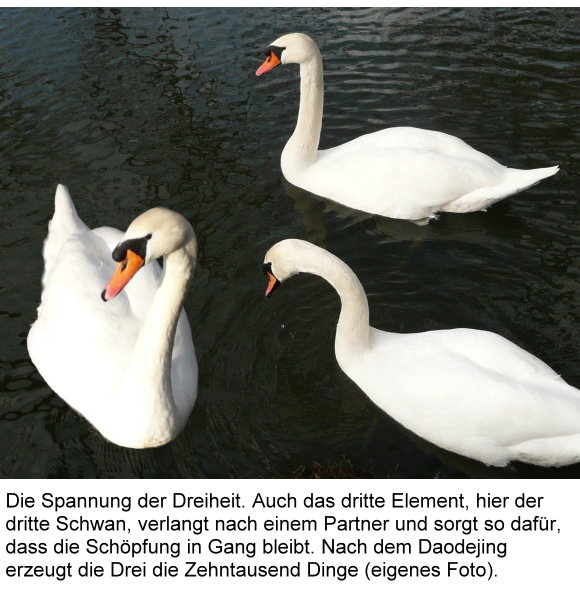
die-spannung-der-dreiheit-drei-schwane.jpg

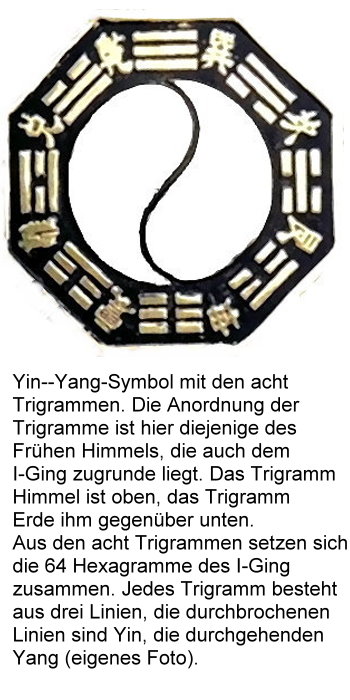
die-spannung-der-dreiheit-die-8-trigramme-fruher-himmel.jpg

Die Spannung der Dreiheit in Beginn und Auflösung der Jahreszeiten bei ihrer Darstellung durch die 64 Hexagramme des I-Ging im Sechser-Rhythmus, der Basis des (sumerischen) Seximal-Systems !

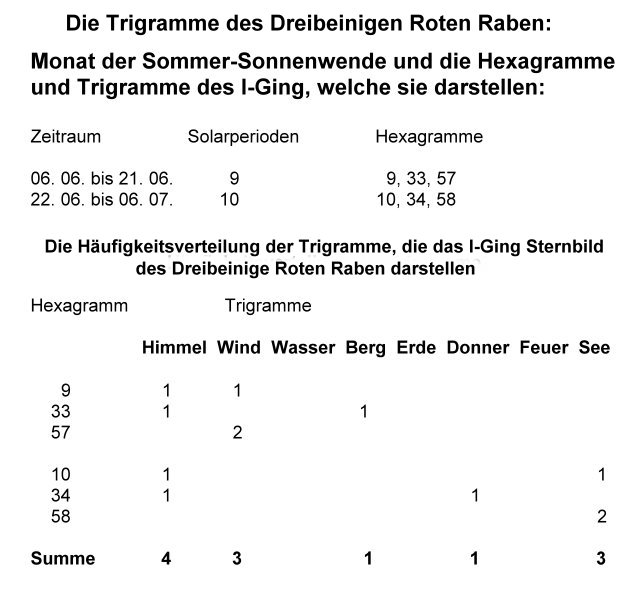
 Im Alten China wurden den 365 Tagen des Sonnenjahres 24 Solarperioden zugeordnet. (Wie bei den 24 Stunden eines Tages ist das vier mal sechs, für jede Jahreszeit 6 Hexagramme. Der Sechser-Rhythmus ist die Basis des (sumerischen) Seximal-Systems.) Zwei Solarperioden umfassen etwa einen Monat. Die 64 Hexagramme des I-Ging stellen diese Solarperioden der Reihe nach dar, und zwar die Hexagramme 1 bis 24  die 24 Solarperioden eines ersten Jahres, die Hexagramme 25 bis 48 die 24 Solarperioden eines zweiten Jahres und die Hexagramme 49 bis 64 die am Anfang stehenden 18 Solarperioden eines dritten unvollständigen Jahres. Jeweils zwei Solarperioden (1 Monat) bilden die Jahreszeiten-Anfänge, nämlich den Frühlings-,  Sommer-, Herbst- und Winter-Anfang und jeweils zwei Solarperioden bilden die Jahreszeiten-Ausklänge Frühlings-. Sommer, Herbst- und Winter-Ausklang. Die Tagundnachtgleichen und Sonnenwenden stehen in der Mitte zwischen den Jahreszeiten-Anfängen und Jahreszeiten-Ausklängen, entweder eine Tagundnachtgleiche oder eine Sonnenwende. Sie werden ebenfalls jeweils durch zwei Solarperioden dargestellt.  Auf die genannten Zeiträume fällt dabei jeweils ein Hexagramm-Paar. Hexagramm-Paare bilden insbesondere von der Form her, aber auch von der Bedeutung her eine Einheit. Auf eine Jahreszeit insgesamt entfallen 6 Hexagramme.

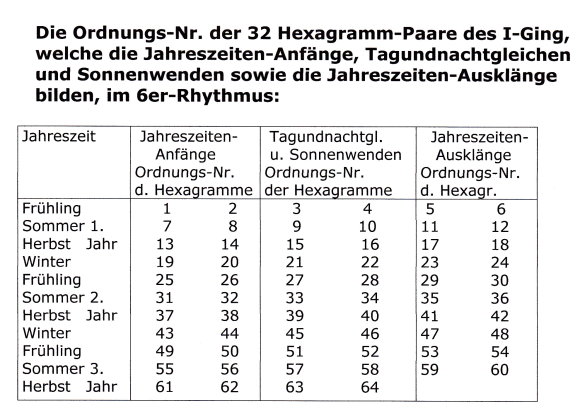
Die Ordnungs-Nr. der Hexagramme der Jahreszeiten-Anfänge, der Tagundnachtgleichen und Sonnenwenden sowie der Jahreszeiten-Ausklänge von zwei und zweidrittel Jahren gehen aus der folgenden Tabelle 1 hervor:

die-spannung-tabelle-1.jpg


In dieser Tabelle sind die Ordnungs-Nr. der Hexagramme des I-Ging in einem 6er-Rhythmus angeordnet. Die Zahlen in den beiden ersten Spalten, die mit 1 und 2 beginnen, sind die Ordnungs-Nr. der Hexagramme, welche die Jahreszeiten-Anfänge bilden, die Zahlen in den beiden folgenden Spalten, die mit 3 und 4 beginnen, sind die Ordnungs-Nr. der Hexagramme, welche die Tagundnachtgleichen und Sonnenwenden darstellen und die Zahlen in den beiden letzten Spalten, die mit 5 und 6 beginnen, sind die Ordnungs-Nr. der Hexagramme der der Jahreszeiten-Ausklänge. Die beiden Zahlen, die in einer Spalte nebeneinander stehen, sind jeweils die beiden Ordnungs-Nr. eines Hexagramm-Paares, das wie gesagt, eine Einheit bildet. Das Hexagramm mit der ungeraden Ordnungszahl gilt als der männliche, das Hexagramm mit der geraden daneben stehenden Ordnungszahl als der weibliche Partner des Hexagramm-Paares.

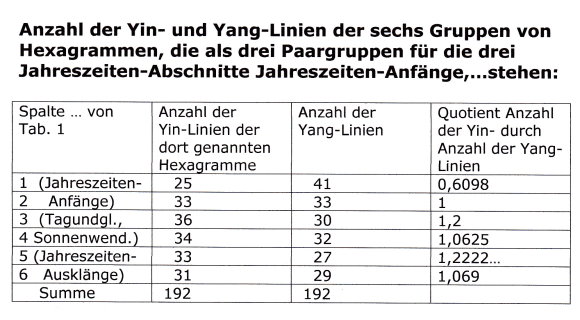
Die erste Spalte der Tabelle, die mit der 1 beginnt, enthält Primzahlen, die sich von der 1 ableiten. Sie enthält 11 Zahlen, davon sind 7 Primzahlen im herkömmlichen Sinne. Die 1 mitgezählt sind es 8. Die 11 Zahlen in Spalte 1 sind die Ordnungs-Nr. der männlichen Hexagramme der Jahreszeiten-Anfänge. In diesen Hexagrammen überwiegen in starkem Masse die Yang-Linien, die Aktivität und Kreativität bedeuten, Aktivitäten, welche die Jahreszeiten-Anfänge, insbesondere den Frühlings-Anfang charakterisieren. Jedes Hexagramm besteht aus sechs Linien, von denen jede einzelne entweder Yin oder Yang sein kann. Bei 11 Hexagrammen sind das 66 Linien. Von diesen 66 Linien der Hexagramme, deren Ordnungs-Nr. in der ersten mit 1 beginnenden Spalte stehen. sind 41 Yang- und 25 Yin-Linien. Die Anzahl der Yang-Linien überwiegt diejenige der Yin-Linien um 16. Der Quotient der Anzahl der Yin-Linien durch die Anzahl der Yang-Linien, nämlich 25/41 = 0,6098. Dieser Wert liegt nahe bei der Zahl des Goldenen Schnitts 0,618, die bei Wachstumsprozessen von großer Bedeutung ist. Bei den weiblichen Partnern dieser Hexagramme ist die Anzahl der Yin-Linien so groß wie die Anzahl der Yang-Linien, nämlich je 33.

Die Spalte 5 der Tabelle enthält Primzahlen, die sich von der 5 ableiten. Insgesamt 9 der 10 Zahlen sind Primzahlen. Die 10 Zahlen sind die Ordnungs-Nr. der männlichen Hexagramme der Paargruppe, die für die Jahreszeiten-Ausklänge stehen. Von den 60 Linien dieser Hexagramme sind 33 Yin- und 27 Yang-Linien. Hier übertrifft die Anzahl der Yin-Linien diejenigen der Yang-Linien um 6. Der Quotient von Yin zu Yang 33/27 = 1,222.. Das ist aufgerundet der doppelte Wert von 0,6098, dem Quotienten von Yin zu Yang der Hexagramme der Spalte 1, den männlichen Hexagrammen für die Jahreszeiten-Anfänge. Spalte 6 enthält die weiblichen Partner dieser männlichen Hexagramme. Die Hexagramme beider Spalten, der Spalte 5 und der Spalte 6 stehen für die Jahreszeiten-Ausklänge. Bei den weiblichen Hexagrammen dieser Paargruppe überwiegt die Anzahl der Yin-Linien diejenigen der Yang-Linien um 2.

 die-spannung-tabelle-2.jpg


Die Vorbedeutung der Hexagramme in Spalte 1, Tabelle 1, den männlichen Hexagrammen der Jahreszeiten-Anfänge, ist bei praktisch allen 11 Hexagrammen vorwiegend positiv. Dies stimmt damit überein, dass bei diesen 11 Hexagrammen die Anzahl der Yang-Linien diejenigen der Yin-Linien deutlich überwiegt, nämlich mit 41 zu 25. Die Vorbedeutung fast aller zugehörigen weiblichen Hexagramme in Spalte 2 ist ebenfalls vorwiegend positiv, obwohl bei ihnen die Anzahl der Yin-Linien so groß ist wie diejenige der Yang-Linien. Die Hexagramm-Paare in den beiden ersten Spalten von Tabelle 1, die für die Jahreszeiten-Anfänge stehen, symbolisieren wie das Yang die Schöpfung.


Die Quersummen der Ordnungs-Nr. der Hexagramme in Spalte 5, Tabelle 1, die männlichen Hexagramme der Jahreszeiten-Ausklänge, sind bei 4 Hexagrammen 5, bei 3 Hexagrammen 2 und ebenfalls bei 3en 8. Wenn die Quersumme der Ordnungs-Nr. der Hexagramme 8 beträgt, ist die Vorbedeutung der Hexagramme vorwiegend positiv. Das sind die Hexagramme 17, 35 und 53. Im Falle der Quersummen 5 und 2 ist die Vorbedeutung der Hexagramme dagegen vorwiegend negativ. Eine Ausnahme bildet dabei Hexagramm 11, welches ”Der Friede” bedeutet. 4 Hexagrammen mit vorwiegend positiver Vorbedeutung stehen also 6 Hexagramme mit vorwiegend negativer Vorbedeutung gegenüber. Dies stimmt damit überein, dass bei diesen 10 Hexagrammen die Anzahl der Yin-Linien diejenigen der Yang-Linien überwiegt, bei insgesamt 60 um 6.

Die Vorbedeutung ist bei Hexagramm 5  “Das Warten”,

bei Hexagramm 23  “Der Verfall”,

bei Hexagramm 29  ”Das Wasser”, das Gefahr, Unglück und schwierige Lage bedeutet,

bei Hexagramm 41  “Die Verringerung”,

bei Hexagramm 47  “Die Bedrängnis” und

bei Hexagramm 59  ”Die Zerstreuung und Auflösung”.

Die Bedeutung der Hexagramme in Spalte 1, die für die Jahreszeiten-Anfänge stehen, ist folgende:

Hexagramm 1:  “Das Schöpferische”,

Hexagramm 7:  ”Das Heer”,

Hexagramm 13: “Die Bruderschaft der Menschen”,

Hexagramm 19: “Die Annäherung”,

Hexagramm 25: “Das Unerwartete (Die Unschuld)”,

Hexagramm 31: “Die Anziehung (Die Anregung)”,

Hexagramm 37: “Die Familie”,

Hexagramm 43: “Die Entschlossenheit”,

Hexagramm 49: “Die Revolution”,

Hexagramm 55: “Die Größe” und von

Hexagramm 61: “Die Innere Wahrhaftigkeit”.

In der Bedeutung einiger Hexagramme scheint der 24er Rhythmus durch. Die Hexagramme 1, 25 und 49

stehen für den Frühlings- und Jahres-Anfang in den zweizweidrittel Jahren, welche die 64 Hexagramme des 

I-Ging darstellen. Hexagramm 49 “Die Revolution” am Anfang des dritten Jahres steht auch für einen Neubeginn

auf der sozialen Ebene. Hexagramm 13 “Die Bruderschaft der Menschen” im ersten Jahr entspricht

Hexagramm 37 “Die Familie” 24 Hexagramme später im 2. Jahr und Hexagramm 41 “Die Innere Wahrhaftigkeit”

im dritten Jahr.

Die Bedeutung der 3 Hexagramme mit der Quersumme 8 ihrer Ordnungs.Nr. in Spalte 5 ist
bei Hexagramm 17  “Die Folge”, die glückliche Umstände verheißt,

bei Hexagramm 35  “Der Fortschritt” und

bei Hexagramm 53  “Die Allmähliche Entwicklung”.

Die Vorbedeutung der meisten der zugehörigen weiblichen Hexagramme in Spalte 6 ist ebenfalls vorwiegend negativ. Die Hexagramm-Paare in den beiden letzten Spalten von Tabelle 1, die für die Jahreszeiten-Ausklänge stehen, symbolisieren wie das Yin die Auflösung.

Die Hexagramm-Paare in den Spalten 3 und 4 von Tabelle 1, welche die Tagundnachtgleichen und die Sonnenwenden darstellen, stehen von ihrer Vorbedeutung in Bezug auf vorwiegend positiv oder negativ her etwa in der Mitte zwischen den Hexagramm-Paaren für die Jahreszeiten-Anfänge und den Hexagramm-Paaren für den Jahreszeiten-Ausklänge.

Wenn es kein Zufall ist, dass die oben erwähnten 3 Hexagramme, deren Ordnungs-Nr. die Quersumme 8 aufweisen, im Gegensatz zu den zugehörigen anderen, von vorwiegend positiver Vorbedeutung sind, so ist dies ein weiterer Hinweis darauf, dass die Numerologie im I-Ging eine  Rolle spielt. Die 8 gilt bekanntlich als sehr positive Zahl.

Vor diesem Hintergrund stellt sich die Frage: Gibt es Unterschiede in den Ordnungs-Nr. der Hexagramme in Spalte 1 und den Ordnungs-Nr. der Hexagramme in Spalte 5, die etwa mit Anfang und Ende, Schöpfung und Auflösung zu tun haben?

Die Ordnungs-Nr. der Hexagramme in Spalte 1 und in Spalte 5 sind, abgesehen von der 1 in Spalte 1, Zahlen-Zwillinge, vor allem Primzahl-Zwillinge, nämlich 7 und 5, 13 und 11, 19 und 17, 25 und 23 (25 ist keine Primzahl.), 31 und 29, 37 und 35 (35 ist keine Primzahl.),43 und 41, 49 und 47 (49 ist keine Primzahl., 55 und 53 (55 ist keine Primzahl.) sowie 61 und 59.

Die Bildungsformel für die Ordnungs-Nr. der Hexagramme in Spalte 1 ist: 6n + 1 mit n = 0, 1, 2, …10,

die Bildungsformel für die Ordnungs-Nr. der Hexagramme in Spalte 5 ist: 6n – 1 mit n = 1, 2, 3, …10.

Die Ausgangsbasis für jeden Zahlen-Zwilling ist 6n mit n = 1, 2, 3, …10. Das sind die Zahlen 6, 12, 18, 24, … 60 bzw. 3, 6, 9, 12, …30 Zweiergruppen. Die Ordnungs-Nr. der schöpferischen Hexagramme in in Spalte 1, entstehen, abgesehen von der 1, dadurch, dass zu der vorhergehenden Zweiergruppe eine 1 hinzugefügt wird. Auf diese Weise entsteht eine Dreiergruppe. Jede Ordnungs-Nr. eines Hexagramms aus Spalte 1, um das es gerade geht, gehört also einer Dreiergruppe an. Von der Drei aber heißt es in Kap. 42 des Daodejing, der bedeutendsten chinesischen Weisheitsschrift, dass sie die Schöpfung in Gang setzt. Die betreffende Passage lautet:

„Die Eins erschafft die Zwei,

  die Zwei die Drei und

  die Drei die Zehntausend Dinge.“


Warum die Drei die Schöpfung in Gang setzt, sieht die Chaos-Forscherin und I-Ging Kennerin Katya Walter (Chaos-Forschung, I-Ging und genetischer Code, Diederichs-Verlag, 1992) in folgendem:

Nach ihrer Auffassung sind hierfür die gleichen Gründe verantwortlich, wie sie in der Chaostheorie die Entwicklung vondynamischen Prozessen beschreiben.

“Immer wenn drei analoge Größen in Beziehung zueinander auftauchen“,

schreibt sie, „entsteht eine Spannung, die das Auftauchen des vierten Pols, der vierten Größe verlangt. Sie muß auftauchen; es gibt keine andere Möglichkeit. Dies entspricht dem polarisierenden und bezogenen Charakter analoger Zahlen…” (Analoge Zahlen sieht die Forscherin und Philosophin im Gegensatz zu linearen Zahlen. Der Begriff “linear” steht bei ihr für das logische, der Begriff

“analog” für das ganzheitliche Denken.)

“… Diese Kraft ist archetypisch. Sie ist überall … in Zahlen, in

  zusammengesetzten Dingen, selbst in Witzen. Wir sollten sie nicht ausstoßen, denn sie ist die Quelle für alles Schöpferische, für das ganze Bindegewebe von Beziehungen. Wir können diese dynamische Funktion der archetypischen analogen Zahl den Erzeuger der Welt nennen.

Dieses Prinzip ist sogar in unsere sexuelle Vermehrung eingebaut.

Das Männliche und das Weibliche zusammen können ein Drittes erschaffen.

Doch sobald dieses Dritte auf der Bühne erscheint, ist die Polarität

unausgeglichen. Denn der Archetyp der Dreiheit bringt die Polarität aus dem Gleichgewicht, ganz gleich, welches Geschlecht das Kind hat. Auch das Kind verdient einen Gefährten …“

„… Eine Vielzahl von Dramen - im literarischen wie im realen Sinne -

drehen sich um diesen Drang der dritten Größe nach natürlicher Erfüllung.

Die Vervollständigung durch die vierte Größe erfolgt in der Regel harmonisch. Dieser Vorgang wiederholt sich ständig im Körper, in der Psyche und im Universum selbst als analoge Dynamik, die die Evolution vorantreibt.

Sobald wir drei Größen in wechselseitiger Beziehung haben, ist alles Weitere eingefädelt. Heißt es doch schon im Tao te king (Daodejing):

Sobald die dritte Größe an ihrem Platz ist, entstehen die zehntausend Dinge.

Die Schöpfung ist auf dem Weg. …”

Soweit Katya Walter.

Die Überlegungen von Katya Walter geben den Grund dafür an, warum die Hexagramme in Spalte 1 für den Jahreszeiten-Anfang und für Schöpfung stehen. Durch das hinzugekommene dritte Element wird die Zweiergruppe zur Dreiergruppe. Das hinzugekommene dritte Element verlangt nach einem Partner und die Schöpfung ist auf dem Weg.


Im Fall der Hexagramme in Spalte 5 wird der letzten Zweiergruppe kein Element hinzugefügt, sondern es geht sogar eines verloren. Es kommt kein drittes Element dazu, das auch nach einem Partner verlangt, sondern die Zweiergruppe wird auf ein Element reduziert, statt Fortschritt findet Rückschritt statt. Dies stimmt damit überein, dass die Hexagramme in Spalte 5  für das Jahreszeiten-Ende und für Auflösung stehen.

Die unterschiedliche Bedeutung der Hexagramme in Spalte 1 und in Spalte 5 von Tabelle 1 hängt also nicht nur von der Verteilung von Yin und Yqng ab, sondern steht also auch in Übereinstimmung mit den Bildungsformeln ihrer Ordnungs-Nr, ein Aspekt der Numerologie, der im I-Ging allem Anschein nach eine Rolle spielt.

Tagundnachtgleichen und Sonnenwenden, ihre Hexagramme und die Ordnungs-Nr. dieser Hexagramme stellen in diesem Zusammenhang den Erhalt der Schöpfung dar. Das lässt sich auch physikalisch begründen. Die Rückkehr der Sonne nach der Winter-Sonnenwende ist z.B. die Voraussetzung dafür, dass die Vegetations-Periode und der Zyklus der Jahreszeiten erneut beginnt.

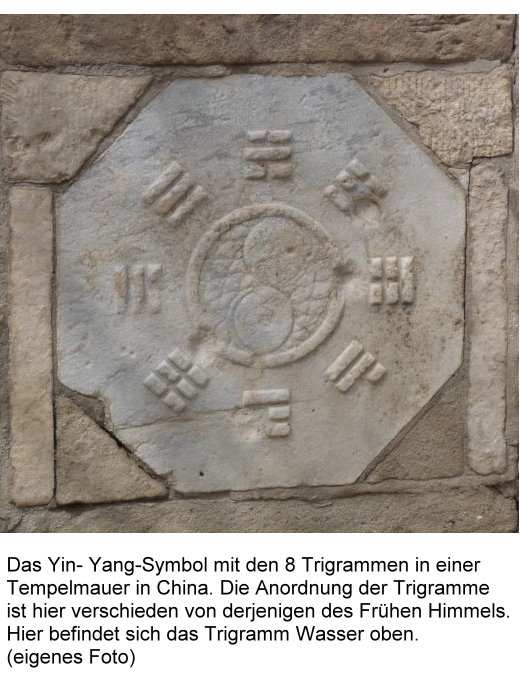
die-spannung-der-dreiheit-trigramm-wasser-oben.jpg

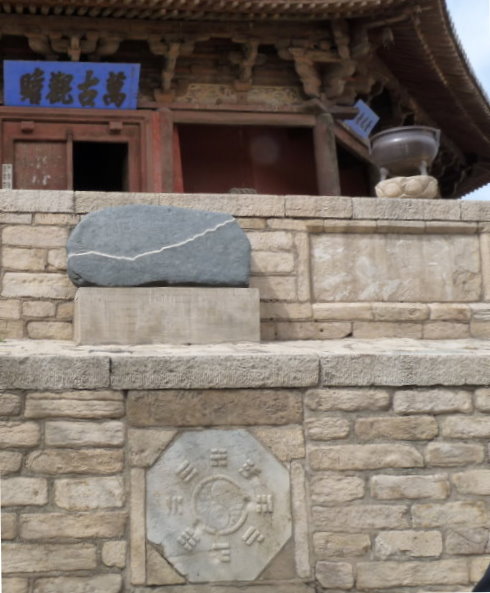
 die-spannung-tempelmauer-mit-symbol.jpg


23.12.2011

I-Ching Secrets, 01.01. to 31.01. 2012: Drachen im Alten China und der Goldene Schnitt!

Abgelegt unter: Allgemein — admin @ 11:04

Waren Drachen im Alten China u.a. deshalb so populär, weil sie von Julia-Graphiken des für Wachstum stehenden Goldenen Schnitts dargestellt wurden?


Der Goldene Schnitt im I-Ging und daraus resultierende  Julia-Graphiken von Drachen für Hexagramm-Gruppen, die Anfang und Ende von Jahreszeiten, Beginn und Auflösung charakterisieren!

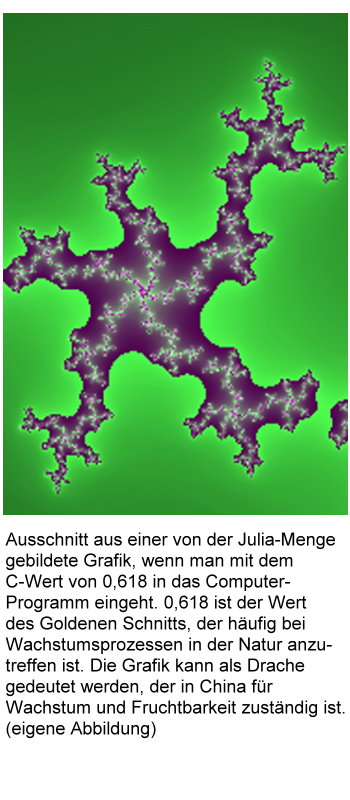
gold-schnitt-drache-einzelnpng.jpg

Im I-Ging gibt es einen Yin/Yang-Quotienten, der nähert sich der Zahl des Goldenen Schnittes 0,618 im Mittel bis auf etwa 1 % an. Es ist der Quotient der Anzahl der Yin-Linien durch die Anzahl der Yang-Linien der bedeutendsten im I-Ging enthaltenen Gruppe von Hexagrammen: Bei der Entschlüsselung der Struktur des I-Ging ergeben sich drei Gruppen von Hexagramm-Paaren. (Hexagramme mit ungerader Ordnungsnummer (männliche Hexagramme) verbinden sich mit Hexagrammen gerader Ordnungsnummer (weibliche Hexagramme), die auf die ungeraden folgen.) Die erste Paargruppe stellt die Jahreszeiten-Anfänge dar. Ihre Hexagramme sind fast alle von überwiegend positiver Vorbedeutung. Die Ordnungszahlen der männlichen Hexagramme dieser Paargruppe sind hauptsächlich Primzahlen. In dieser Gruppe beträgt der Quotient der Anzahl der Yin-Linien durch die Anzahl der Yang-Linien 25/41 gleich  0,6098. Das ist ein Wert nicht weit entfernt von der Zahl des Goldenen Schnitts 0,618. (In dieser Gruppe von Hexagrammen verhält sich die Anzahl der Yin-Linien zu der Anzahl der Yang-Linien wie die Anzahl der Yang-Linien 41 zu der Anzahl der Yin-Linien plus der Anzahl der Yang-Linien 66 (25 + 41 = 66). Das ist die Formel für den Goldenen Schnitt.) Der Quotient von 41 zu 66 beträgt 0,62118. Der Goldene Schnitt kennzeichnet eine sich wiederholende Selbstähnlichkeit. Die Natur bevorzugt das Auftreten des Goldenen Schnitts. Der Goldene Schnitt ist u.a. in Wachstumsprozessen zu finden. Er beinhaltet eine sich wiederholende Selbstähnlichkeit, wie sie u.a. im Blumenkohl zu finden ist. Ein Blumenkohl besteht aus kleineren Röschen, die dem gesamten Kopf sehr ähnlich sehen. Diese Röschen lassen sich in noch kleinere zerlegen, die den vorhergehenden und auch dem ganzen Kopf ähnlich sind. Diese Selbstähnlichkeit ist in drei bis vier Stufen vorhanden. Die Natur kopiert auch in vielen anderen Strukturen immer wieder ein Grundmuster in immer kleinerem Maßstab. Selbstähnlichkeit beinhaltende Wachstumsprozesse werden auch von der Julia-Menge dargestellt, die durch ihre formen-reiche Graphiken bekannt ist. Sie steht in Beziehung zur Mandelbrot-Menge. Da im I-Ging der Goldene Schnitt vorhanden ist, fragte sich der Autor, ob Yin-Yang-Strukturen im I-Ging nicht auch von Julia-Mengen dargestellt werden können. Mandelbrot- und Julia-Mengen sind geometrische Gebilde mit einer hohen inneren Ordnung und vielen Symmetrien. Die Mandelbrot-Menge  ist zugleich ein Symbol für das mathematische Chaos.


Das I-Ging enthält 64 Hexagramme, die 32 Hexagramm-Paare bilden. Ein Hexagramm mit einer geraden Ordnungsnummer ist der weibliche Partner des vorangehenden männlichen Hexagramms mit einer ungeraden Ordnungsnummer. In den meisten Fällen ist das weibliche Hexagramm das auf den Kopf gestellte Hexagramm des vorangehenden männlichen Hexagramms. Nicht nur von der Form, auch von der Bedeutung her bestehen Verbindungen.

Um Julia-Mengen darstellen zu können, kann man die Hexagramm-Paare als komplexe Zahlen auffassen. Man kann aber auch jedes einzelne Hexagramm wegen seiner unterschiedlichen Anteile von Yin und Yang als komplexe Zahl auffassen. Als erstes ist da die Anzahl der Yin- und Yang-Linien in einem Hexagramm bzw. in einer Gruppe von Hexagrammen. Aufgrund ihrer Lage in einem Hexagramm kann der Anteil von Yin bzw. Yang aber auch über diese ganzzahligen Anteile hinausgehen. Mit Hilfe eines Computer-Programms wird der Betrag der komplexen Zahlen sowie das Produkt von jeweils zwei komplexen Zahlen berechnet.

So wie eine Gruppe von Hexagramm-Paaren für die Jahreszeiten-Anfänge und den Beginn steht, so stellt eine andere Gruppe von Hexagramm-Paaren die Jahreszeiten-Ausklänge und die Auflösung dar. In der ersten Gruppe sind fast alle Hexagramme von vorwiegend positiver Vorbedeutung. In der zweiten Gruppe ist demgegenüber etwa die Hälfte der Hexagramme von vorwiegend negativer Vorbedeutung. Der Autor fragte sich, ob sich nicht für diese beiden Gruppen von Hexagramm-Paaren unterschiedliche Julia-Grafiken ergeben, die in etwa der Bedeutung dieser beiden Hexagramm-Gruppen entsprechen. Er ging dazu mit Quotienten von Yin durch Yang als C-Werte in das Programm XFract0.2.2.1-Universal zur Berechnung von Julia-Mengen ein. Bei den Grafiken, die das Programm liefert, liegen die Punkte im schwarzen Bereich innerhalb der Julia-Menge. Den Punkten außerhalb der Julia-Menge werden unterschiedliche Farben zugewiesen. Die Farbe der Punkte ist abhängig von der Anzahl der Iterationen, die der Computer berechnet hat, um herauszufinden, dass sie außerhalb der Julia-Menge liegen. Die Formel z-Quadrat wird immer wieder auf z angewendet. Die Anzahl der Anwendungen ist die Anzahl der Iterationen. Z und der C-Wert c sind komplexe Zahlen.


Der Zahlenwert für den Goldenen Schnitt 0,618 wurde als C-Wert für die Berechnung der Julia-Menge verwendet, desweiteren auch der sich aus dem I-Ging ergebende, an den Goldenen Schnitt angenäherte Zahlenwert von 25/41 = 0,6098 bzw. 41/66 = 0,621. Die Grenzen für x und y wurden mit -1,5 und +1,5 eingegeben. In ähnlicher Weise wie die Mandelbrot-Menge liefert auch die Julia-Menge u.a. Bilder von Fraktalen. Fraktale weisen Selbstähnlichkeit auf, d.h. die Teilfiguren sind verkleinerte Kopien der Gesamtfigur, ein Phänomen, das wie erwähnt auch bei Wachstumsprozessen in der Natur eine große Rolle spielt..

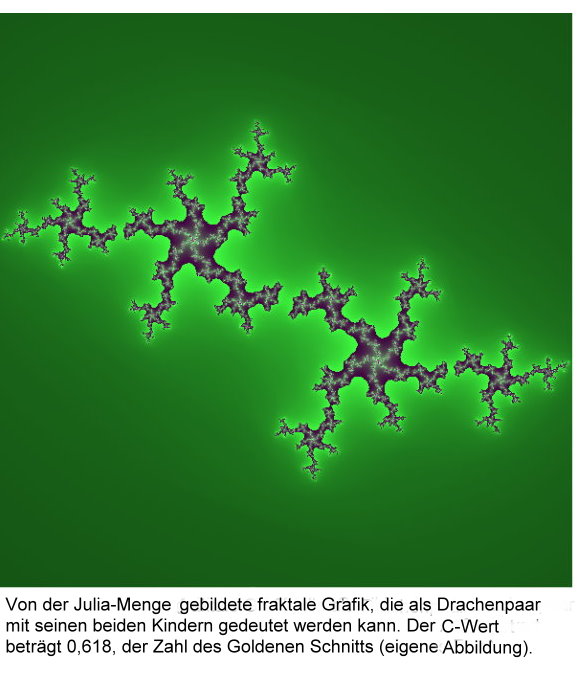
Wird der Zahlenwert von 0,618 des Goldenen Schnitts als C-Wert verwendet, so ergibt sich eine Grafik, die als ein Drachenpaar mit seinen beiden Kindern gedeutet werden kann.

gold-schnitt-drachenpaar-mit-seinen-beiden-kindern.jpg

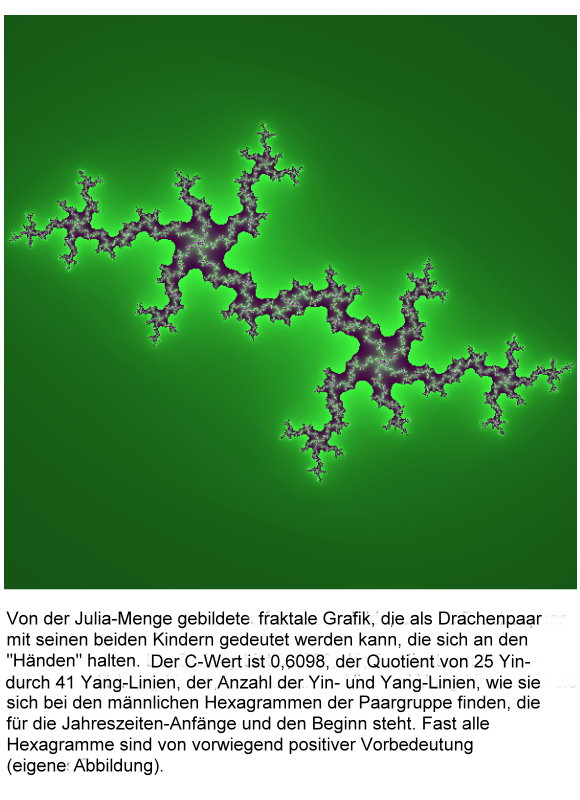
Wird der geringfügig vom Goldenen Schnitt abweichende Wert von 25/41 = 0,6088 (das Verhältnis von kleinerer Strecke oder Menge zu größerer Strecke oder Menge als Teil 1 der Gleichung des Goldenen Schnitts) als C-Wert verwendet, wie er sich für die männlichen Hexagramme der für die Jahreszeiten-Anfänge und den Beginn stehenden Hexagramm-Paare ergibt, so sind das Drachenpaar und seine Kindern nicht mehr wie bei dem C-Wert des Goldenen Schnitts voneinander getrennt, sondern miteinander verbunden. Sie halten sich sozusagen an den „Händen“.

gold-schnitt-drachenpaar-mit-kindern-die-sich-an-den-handen-halten.jpg

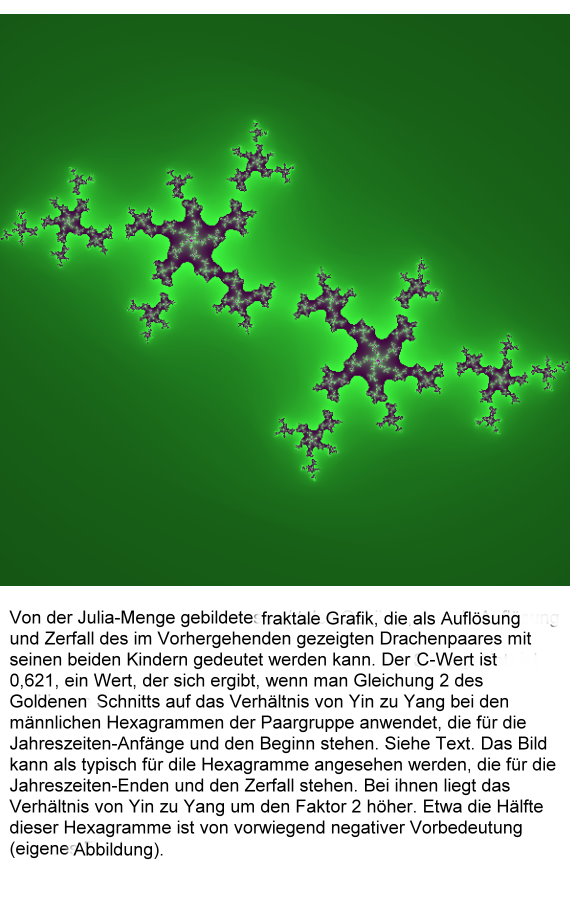
Der vom Goldenen Schnitt etwas nach oben abweichende C-Wert von 41/66 = 0,621 (das Verhältnis von größerer Strecke oder Menge zur Gesamtstrecke oder –menge als Teil 2 der Gleichung des Goldenen Schnitts) führt zu einer Julia-Grafik, in welcher die Julia-Menge in eine Reihe einzelner Teile zerfällt. Das Bild symbolisiert Auflösung und entspricht der Hexagramm-Gruppe, die für die Jahreszeiten-Enden bzw. die Auflösung steht. Die Zahl 2 als Entsprechung zu Gleichung 2 der beiden Gleichungen des Goldenen Schnitts taucht bei dieser Gruppe insofern auf, als dass der Quotient der Yin- durch die Yang-Linien von 33/27 = 1,222 bei den männlichen Hexagrammen dieser Paargruppe zweimal so groß ist wie bei den männlichen Hexagrammen der Paargruppe, die für die Jahreszeiten-Anfänge und den Beginn steht.

gold-schnitt-zerfallende-strukturen.jpg

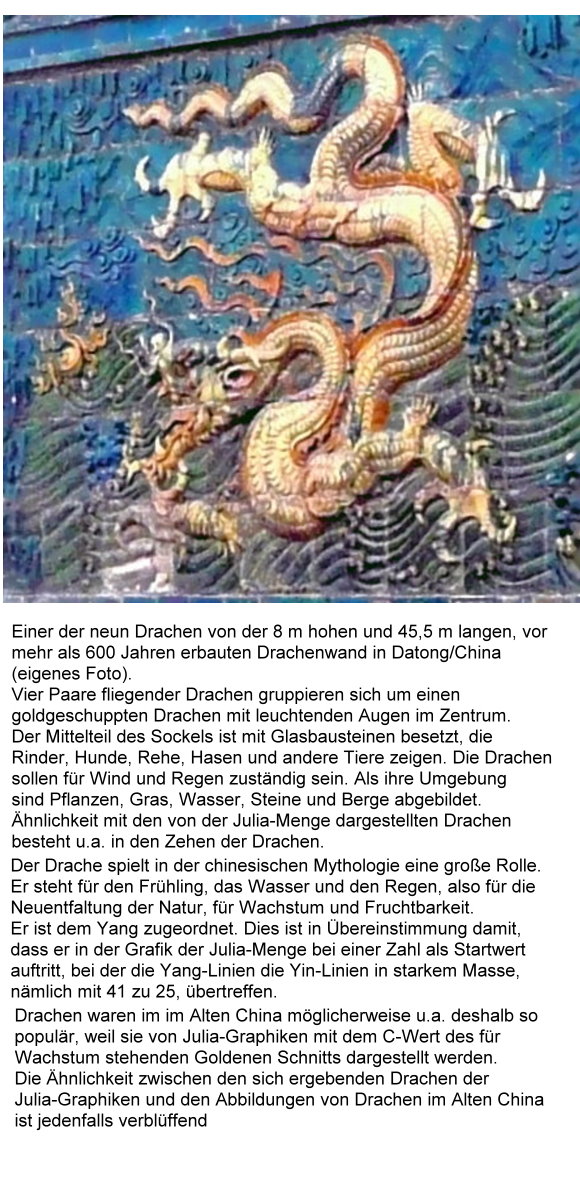
Der Drache spielt in der chinesischen Mythologie eine große Rolle. Er steht für den Frühling, das Wasser und den Regen, also für die Neuentfaltung der Natur, für Wachstum und Fruchtbarkeit. Er ist dem Yang zugeordnet. Dies ist in Übereinstimmung damit, dass der Drache in der Grafik einer Julia-Menge bei einer Zahl als C-Wert auftritt, bei der die Yang-Linien die Yin-Linien in starkem Masse, nämlich mit 41 zu 25, übertreffen.

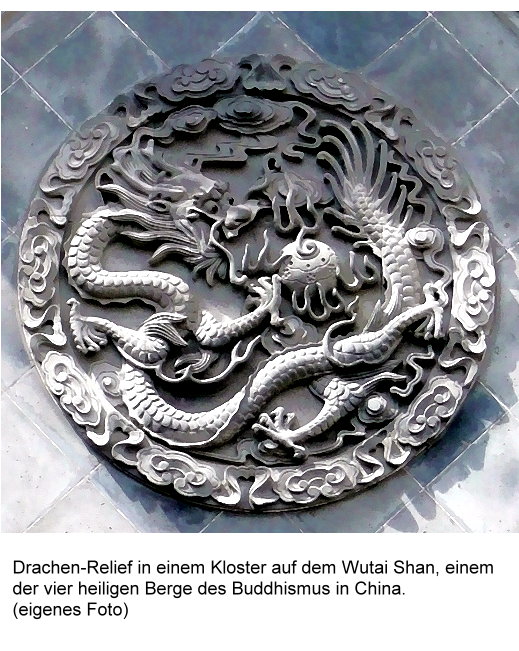
Der Autor hält es für möglich, dass Drachen im Alten China u.a. deshalb so populär waren, weil chinesische Mathematiker herausgefunden hatten, dass sie von Julia-Graphiken mit dem C-Wert des für Wachstum stehenden Goldenen Schnitts dargestellt werden. Die Ähnlichkeit zwischen den Drachen, die von den Julia-Grafiken dargestellt werden und den Abbildungen von Drachen im Alten China ist jedenfalls verblüffend.

gold-schnitt-drachen-relief-auf-dem-wutai-shan.jpg

gold-schnitt-2-drache-von-der-drachenwand-in-datong-china.jpg

23.9.2011

I Ching Secrets 26.09. to 23.10. 2011: The most important Emblem of the Earth in its relation to the Sun!

Abgelegt unter: Allgemein — admin @ 15:45

great-purity-emblem.jpg

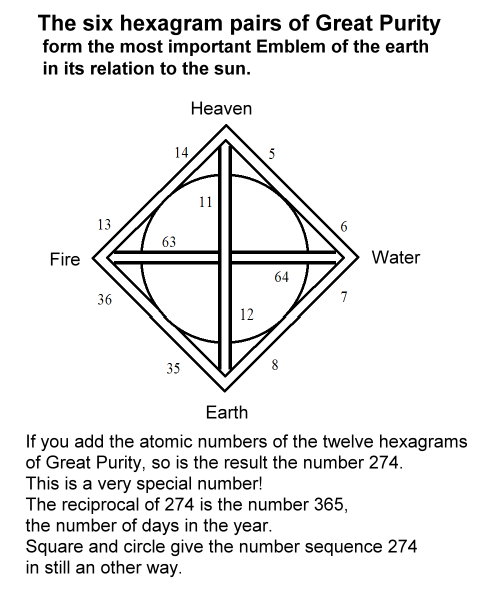
The six hexagram pairs of Great Purity

  - Emblem of the revolution of the earth around the sun.

  A square standing on a corner with a circle in it and a cross connecting the corners  - the emblem for the number of days in the year.


      Just as there are hexagram pairs of Great Harmony, so there are hexagram pairs of Great Purity. Eight hexagram pairs of Great Harmony and six hexagram pairs of Great Purity. Of the latter, only six, as the the double signs have no mirror partners.

  The eight hexagram pairs of Great Harmony form the emblem of Mother Earth. But what emblem represent the six hexagram pairs of Great Purity?

   If they are graphically represented in the circle of Early Heaven they form a square standing on a corner with a cross connecting the corner of this figure (Fig. 1).

  The Earth-Emblem is formed by the eight hexagram pairs of Great Harmony. What may form the six hexagram-pairs resp. 12 hexagrams of Great Purity. The number twelve could mean that they have something to do with time, with the twelve lunar months in the year or the twelve double-hours a day.

  Purity is something that is reserved for the sky. For the Earth the Old Chinese wished harmony, but the earth was not thought to be a place of great purity. As purity is a property of the sky, the twelve hexagrams of Great Purity could have something to do with the sky. But these hexagrams also represent graphically a square standing on a corner with a cross in it. This is in a slightly distorted way also the Emblem for Mother Earth..

  According to the commentary of R. William to the second line of hexagram 2, the double sign Earth, the square is the symbol of the earth, just as the circle is the symbol of heaven.

  Square and circle in ancient China played a special role in mathematics. This emerges from a mathematical work, whose title is:

  “The classical arithmetic of the gnomon (gnomon to determine the low sun) and the circular path of heaven.”

  It is apparently created in the 6th Century BC.

  In an interview there is mentioned  a theorem about the right-angled triangle, which is known in the West as the Pythagorean theorem.

  Furthermore,mentioned is the importance of the circle in a square, which was obviously regarded as fundamental:

  “… The art of counting”, it says there, “goes back to the circle and the square. The circle is derived from the square and the square from a rectangle …

  The square belongs to the earth, the circle to the sky because the sky is round and the earth square ….” In this text, so too the square represents the earth and the circle the sky. Square and circle are described as closely related.

  The square-figure standing on a corner with a cross connecting the corners, as shown in Fig. 1, together with the circle could characterize the earth in its connection with the sky. In the figure, a measure is included, which reflects the role of Earth in its relationship to the circling of the sun.

  The I Ching was used not only as an oracle and book of wisdom, but also a solar-lunar calendar, which showed the farmers the right time to pursue their activities in harmony with the DAO. For the people of earlier times living on agriculture, the knowledge of the number of days in the year and the dates of the equinoxes and solstices were of great importance and by no means self-evident.

  The moon determined the length of the synodic month of 29 ½ days, the sun the length of the solar year of 365 ¼ days. The ancient Chinese calendar was not limited to the fixing of years, months and days. It also included predictions of the apparent movement of the sun, moon and five visible planets, and it also contained the prediction of solar and lunar eclipses.

  Each of the six pairs of parallel lines represents a hexagram pair, a hexagram with an odd and the following hexagram with an even atomic number. There are only six hexagram-pairs, who are also pairs of lines.

  The (female) hexagram with the straight atomic number of a pair contains the same trigrams as the male, but the order is reversed. The two partners mirror each other. Therefore they are a hexagram-pair of Great Purity.

  Most of the 12 hexagrams of Great Purity contain a predominantly favorable prognosis.

  The following table contains the names of the 12 hexagrams of Great Purity and also the 12 solar periods for which they stand:

  Table 1

  The six hexagram pairs of Great Purity

Hexagram                          Solar period


 5) Waiting                       5 End of Spring  

 6) Conflict                       6 End of Spring  

 7) The Army                    7 Early Summer

 8 )  Holding Together         8 Early Summer

11) Peace                        11 End of Summer

12) Standstill (Stagnation 12 End of Summer

13) Fellowship with Men    13 Early Autumn

14) Possession

      in Great Measure        14 Early Autumn  

35) Progress                     11 End of Summer

36) Darkening of the Light 12 End of Summer

63) After Completion         15 Autumn Equinox

64) Before Completion       16 Autumn Equinox

274 = Total of the Ordinal numbers


If you look at the name of hexagram 36, which represents one of the lines in the table above, one is astounded, because her name is: “The eclipse of light.” The combination of the atomic number and the name of hexagram 36 apparently refers to the 36 days of the year in which the light of the moon is eclipsed.

  (In every lunar month the moon for three days is virtually invisible.)


(If you add up the numbers 1 to 36:  1 +2 +3 … +36, so is the result the number 666. In the West, the number is ambivalent because it is both the number of the beast of the apocalypse as well as the number of Hakathriels, the Angel of sovereignty. In the Kabbalah 666 is the number of Sorath, the solar demon who stands opposite the Archangel Michael.)


The eight hexagram-pairs of Great Harmony represent no winter- months. The same applies for the six hexagram pairs of Great Purity. The end of summer is twice represented.

  If you add the atomic numbers of the twelve hexagrams of Great Purity, so is the result the number 274.

This is a very special number!

  The reciprocal of 274 is the number 365, the number of days in the year.

The square around a circle is also a symbol for the connection of the earth with the sky! Why?

The figure provides the measure, on which the motion of the Earth is embedded in the solar system.

When the Earth in a year rotates once around the sun, the earth has rotated 365.24 times around itself. For the ancient Chinese, it was of course the sun, which revolves around the earth. In the centuries before our era, when the I Ching received its final form, it was known in China that the length of the solar year is 365 1 / 4 days. The part of the orbit, the Earth every day covers, is 1 / 365, 25 = 0.002737, rounded up to 0.00274 (mean value). This is also the sum of the atomic numbers of the twelve hexagrams of Great Purity.

 But what has this speed, the reciprocal of the number of days per year, to do with the pictorial representation of hexagrams, forming a square? The reason for this is that you get in this way the number sequence 274 in a second way.

When you in the square in Fig. 1 draw a circle with the circumference 1  then the following applies:

The difference between square and circle circumference is

Csquare - Ccircle 4/Pi - 1 = 0.274

The difference between the circumference of the square and the circumference of the circle is thus again the number sequence 274.


The number pi is here, as mentioned, set at 3.14.

Pi is a dimensionless quantity that appears in mathematical formulas that have to do with the calculation of perimeter, area, or content of circle or sphere. In physics formulas, Pi usually arises because the fundamental forces of nature are isotropic, ie they prefer no direction in space.

The reciprocal of 0.274 is again the number sequence 365, so the number of days in the year. This relationship between square and circle was likely known in ancient China and has been supplied the reason why the twelve hexagrams of Great Purity form a square and the sum of their atomic numbers is the number sequence 274.

The number sequence 274 is itself an emblem. M. Granet, in his book “The Chinese Thinking” repeatedly pointed out that the quantitative significance of numbers in ancient China was far behind its symbolism. If anyone has a number of great symbolic value for the position of Earth in the cosmos, then it is the number sequence 274, fewer than the average daily rate, but above all because its reciprocal is the number of days per year.

If could be deduced from the movements of heavenly bodies or from constructions a number, then it was believed, that this number was corresponding to the divine order. This may have been the case for the number sequence 274. If now, still providing for the movement of the earth around the sun, the same sequence of numbers was received as a geometric relationship between a square and the enclosed circle, then it was assumed that between the geometric figure and the apparently movement of the sun around the earth was a connection. The figure, shown here, was therefore particularly suitable for display as an emblem of the most important relationship between heaven and earth.

In the calculations here it was assumed that the number Pi (3.14), the ratio of circumference to diameter of a circle, the Chinese at the time, when the I Ching got its final form, was at least known until two digits after the decimal point. They then had in regard to Pi the same knowledge as the Greek Archimedes in the third century BC

The relationships here spoken of were probably also viewed as confirmation that it was right to choose as a symbol for Mother Earth the square and as a symbol of the heaven the circle.


29.8.2011

I Ching Secrets 29.08 to 25.09.2011:There are only two hexagrams of both great harmony and great purity. They graphically form a cross, possibly the most important Emblem of the I Ching! Furthermore, “Unresolved issues” someone of the readers might be able to solve.

Abgelegt unter: Allgemein — admin @ 17:31

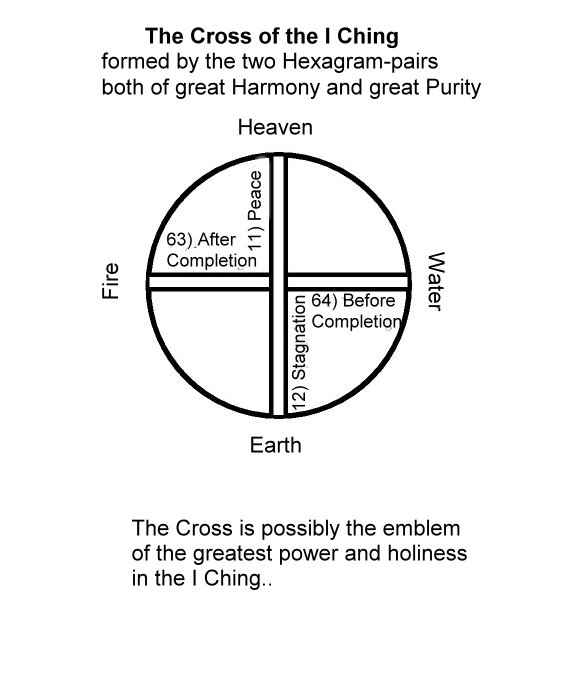
There are only two hexagrams of both great harmony and great purity. They graphically form a cross, possibly the most important Emblem of the I Ching! Furthermore, “Unresolved issues” someone of the readers might be able to solve.


i-ching-the-cross-is-possibly.jpg


The 64 hexagrams of the I Ching are assigned to the 64 solar periods of 2 2 / 3 years. Two solar cycles in the Old China are a month, 24 solar periods a year. The atomic numbers of the hexagrams are grouped into the following three sets of numbers:

a) the natural numbers that are evenly divisible by three.

b) the natural numbers that are evenly divisible by two, but not divisible by three - These numbers are all even and thus .- Female,

c) the other natural numbers, which are predominantly prime. They

    are all odd, and so masculine.


The number of group c) begins with the 1, according to Chinese Mythology is 1 the number of Heaven.

The number of group b) begins with the 2, according to ancient Chinese believe is 2 the number of earth. These hexagrams are all female. The number of group a) begins with the 3, according to ancient Chinese believe is 3 the number of human beings. The members of this group of numbers are both even and odd, therefore both female and male.

The 64 hexagram of the I-Ching form 32 hexagram-pairs. A hexagram with an odd atomic number is united with the hexagram of the following even atomic number to a pair. In light of this pairing from the above three hexagram-groups according to the sequence of natural numbers, three groups of hexagram-pairs with specific characteristics are derived. These characteristics regard the distribution of yin and yang, the distribution of the 8 trigrams (each hexagram consists of two trigrams), are related to mainly positive or negative omen, as well as to  the distribution of the hexagram-pairs on the seasons. In the first group hexagrams of heaven combine with the heaxagrams of earth. The hexagrams of this group are associated with the beginnings of seasons. They are mostly of positive omen. In the second group the hexagrams of the human male combine with the rest of the hexagrams of the earth. The hexagram-pairs of this group are associated with the equinoxes and solstices. In the third group hexagrams of heaven combine with the hexagrams of the human female. The hexagrams-pairs of this group are to the ends of the four seasons. They are mostly of negative omen. (See also the chapter in which the assignments listed here are described in more detail!)


The hexagram pairs of harmony and purity of the hexagram pairs

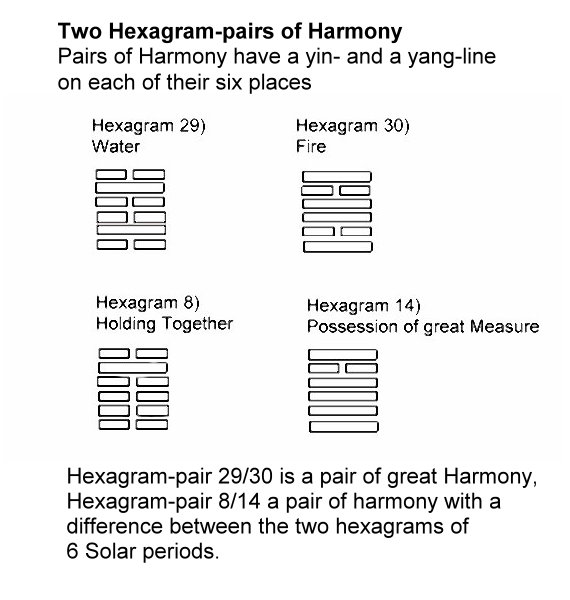
There are also hexagram-pairs of harmony and hexagram-pairs of purity. Hexagram pairs of harmony are those in which one of the two lines on each of the six places of the two hexagrams is yin and the other is yang. The two hexagrams belong also to the same pair-group. If the atomic numbers of the two hexagrams directly follow each other they are a hexagram pairs of great harmony.


Example of two hexagram pairs of Harmony:

i-ching-hexagran-pairs-of-harmony.jpg

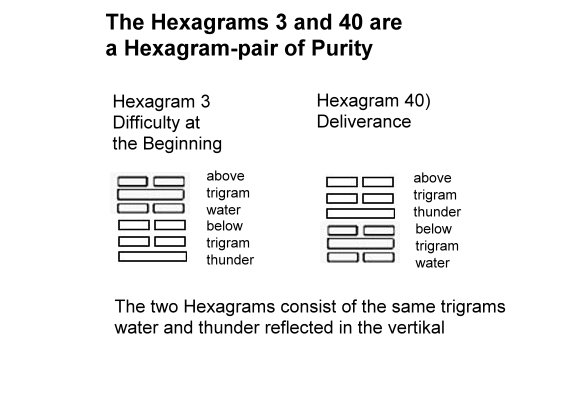
Hexagram pairs of purity are those whose partners mirror each other in the vertical. The two partners then will contain two identical trigrams, but the order is reversed. The upper trigram is transformed into the lower and the lower into the upper trigram. If the atomic numbers of the two hexagrams directly follow each other, they are a hexagram pair of great purity.

Example of a hexagram pair of Purity:

i-ching-a-hexagram-pair-of-purity.jpg

Certain hexagram pairs of harmony resp. purity graphically form important emblems, such as a cross, the plan for a center of power or holiness, “The Threefold Temple of Heaven” and other emblems that will still be discussed.


The Cross in the I Ching


There are only two hexagram pairs of both great harmony and great purity. The one pair (11/12) represents the connection between heaven and earth, which can be either positive or negative, the other pair (63/64), it is the completion to the rule of intellect over instinct. The graphical representation of these two pairs of hexagrams in the circle of the “original heaven” is a cross, an emblem of great power and holiness.


The atomic numbers of the hexagram pairs of harmony

The eight hexagram pairs of great harmony are:

11/12; 17/18, 27/28, 53/54, 61/62, 63/64, 1 / 2, 29/30.

The remaining six hexagram pairs of harmony are:

5 / 35, 6 / 36, 7 / 13, 8 / 14, 51/57, 52/58.


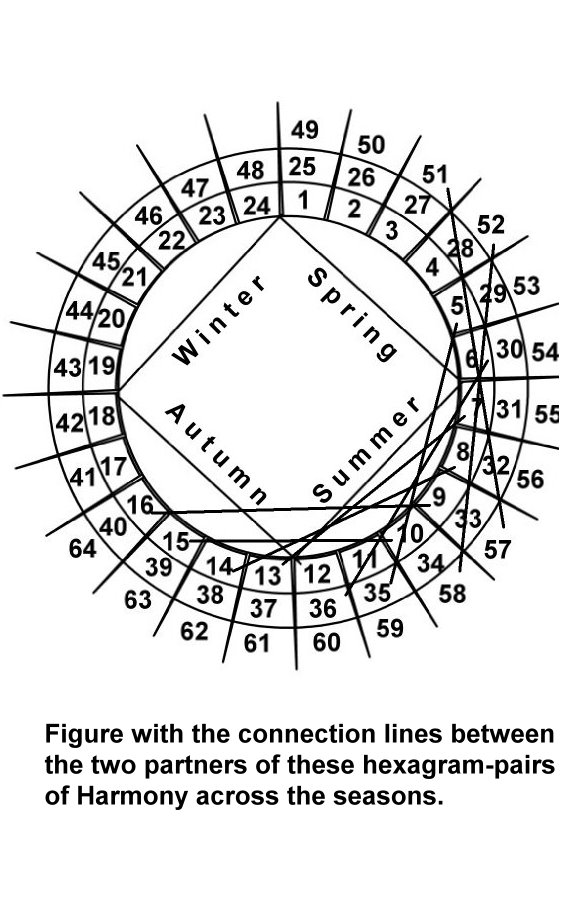
Figure with the connection lines between the two partners of these last hexagram-pairs of Harmony across the seasons.

i-ching-ok-harmony-connection-lines.jpg


The Connection lines – an unresolved issue!


The connections are between male / male or female / female partners. The connections go from the vernal equinox to the summer solstice, the end of spring to the end of summer, from the beginning of summer to the beginning of autumn and from the summer solstice to the autumnal equinox. The distance is always six solar cycles. The connection is three times between equal annual circles and once between the first and the second annual circle.


The atomic numbers of the hexagram pairs of purity

The six hexagram pairs of great purity are:

5 / 6, 7 / 8, 11/12, 13/14, 35/36, 63/64.

The remaining eight hexagram pairs of purity are:

3 / 40, 4 / 39, 47/60, 48/59, 49/38, 50/37, 53/18, 54/17.


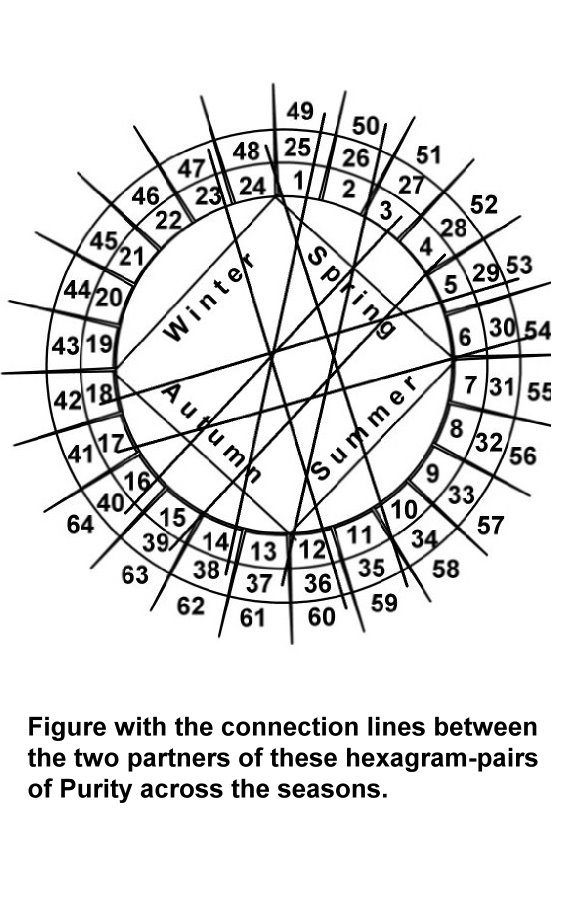
i-ching-ok-purity-connection-lines.jpg 

All connections are between male / female partners. The connections go from the end of winter to the end of summer, from the beginning of spring to the beginning of autumn, from the spring equinox to the autumn equinox and the end of spring to the end of autumn.

The connection is always between different annual circles. The distance is four times 11 and four times 13 solar periods.


Since the winter is represented in the hexagram pairs of harmony and purity only once with a hexagram pair of the end of winter, the hexagram pairs are possibly thought to harmonise  and purify the harvest in agriculture. A good harvest in ancient China was of great importance.

Purity is something that has primarily to do with heaven. The hexagram pairs of purity therefore may have something to do with precipitation and sunshine.

Why the purity partners are not to be found in the neighboring season, as the harmony partners but further away, was the author not able to find out, nor why the harmony partners farther away are of the same sex, while the purity partners are all pairs of different sex. The differences should be related to the conditions for a good harvest in connection with the different ideas about harmony and purity. The hexagram pairs of great harmony and great purity herein are of course not involved, since the atomic numbers of the two partners immediately follow each other and consequently one of the partners is male and the other is female. 


27.7.2011

I Ching Secrets 28.07. to 24.08. 2011: The eleven pairs of the “hexagrams of purity” of the Heaven are forming “The Threefold Temple of Heaven” of the I Ching.

Abgelegt unter: Allgemein — admin @ 18:44

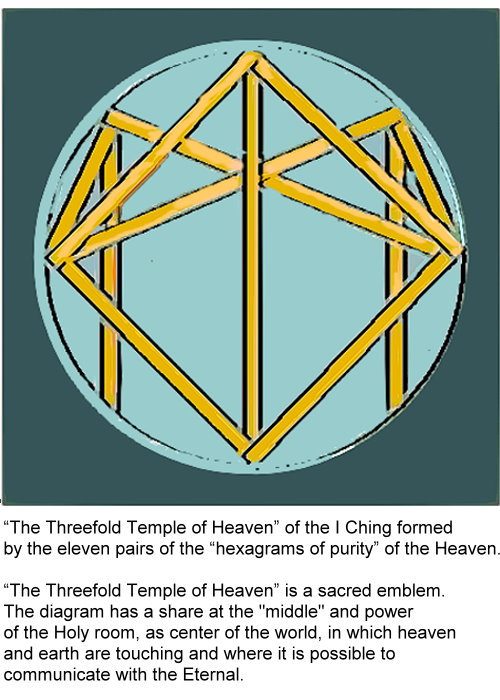
The eleven pairs of the “hexagrams of purity” of the Heaven are forming “The Threefold Temple of Heaven” of the I Ching.

reinheit-3-the-threefold-temple-of-heaven-of-the-i-ching.jpg


Two hexagrams are a couple of purity when the two hexagrams reflect each other in the vertical and belong to the same pair group Heaven / Earth, Heaven / Man or Man / Earth. Then the hexagram pair consists of two identical trigrams in reverse order and the two hexagrams are in the same pair group. The I Ching contains 14 pairs of purity. Eleven of them belong to the pair groups Heaven / Earth and Heaven / Man. In the “Circle of the Early Heaven” graphed, these eleven pairs of purity are forming  “The Threefold Temple of Heaven”.


The I Ching contains star-constellations and the graphical representation of certain hexagrams is the master plan for palaces and monasteries. This being so, the hexagrams of the I Ching may also contain other symbols and emblems, such as those of the Heaven. One had only to find the hidden features of the hexagrams forming these emblems. The idea that such “sacred monuments” were hidden in the I Ching, let me rest any more. If these were really hidden in the I Ching, I had to find them. First I wanted to look for an Emblem as a representative of the Heaven or the great DAO behind Heaven. The highest heavenly power, people have worshiped everywhere on earth and they represented it in a variety of ways.

The holiness of heaven is at countless ritual or mythical complexes … present, “writes Mircea Eliade. “It is through the symbolism of the “height”, the “exit”, the “center”of the religious experience and so alive …”

“The holiness of heaven is at countless ritual or mythical complexes … present, “writes Mircea Eliade. “It is through the symbolism of the “height”, the “exit”, the “center” of the religious experience and so alive …”

I could search for a symbol of the Three Pure Ones, which were probably revered even before the Han dynasty (206 BC-220 AD) in China as the supreme divine power. They are the three manifest forms of the unfathomable DAO, the mother and nurturer of the ten thousand beings. As the highest and most abstract deities they dominate “The Early Heaven”. At the grand festival of the sacrifice they play in Daoist temples the leading role.

The Three Pure Ones are the three highest Gods in the Daoist pantheon. They are regarded as the pure manifestation of the DAO, bringing all sentient beings into existence. The Daoist classic Daodejing, says: “The DAO produced One; One produced Two; Two produced Three; Three produced All things”.

I could also search for an emblem of a mountain.

“The mountains are closer to the sky,” says Eliade, “and this gives them a double sanctity, one hand, they have participated in the spatial symbolism of transcendence (” high “,” vertical “,” Highest “etc.) and on the other hand, they are in the proper sphere, in the heaven, as the abode of the gods. Many mythologies have their holy mountain … “(The Chinese emperors offered the sacrifice to heaven on a mountain.) Often, a mountain is regarded as a point of contact between heaven and earth, so as a center through which the world axis is running - a zone in which the sacred is compressed, a place where the transition between separate regions of the cosmos is possible … “

For the symbolic representation of heavenly powers, if such a representation in the I Ching exists, should the hexagrams of heaven have been used. The hexagrams of heaven and their female partners, I knew. These were the hexagrams of the two pair-groups Heaven / Earth and Heaven / Man, left, the life-giving and right, the strong hand of heaven. But what characteristics these hexagrams should also show? In any case, of course, “purity”. For this was the property of heaven. For the Three Pure as the highest representatives of the heaven, this the name says already.

A creation myth states:

“The pure and light is above in the heaven, the gloom and gravity is below at the earth.”

This statement is attributed to Lieh-tzu, who lived from 440-370 BC.

“Purity” is also associated with the heaven and the DAO in the Daodejing..

Chapter 39 of the Daodejing (DDJ) says:

“By the One (DAO) the heaven attains purity…”

“The heaven without purity, I am afraid he would probably fall apart.”

Chapter 45 of the DDJ then still contains the following execution of the importance of purity:

“Purity is the canon of the world.”


There raised the question which of the hexagrams of heaven in a symbolic way, are “pure.” What means in this context at all “pure”?

I immersed myself in the ancient scriptures and gradually it became clear to me that this property by Daoist and Buddhist conception apparently deemed to exist “if a person uses his heart as a mirror and the things neither pursues nor goes toward them, he reflects but does not keep them … “

According to Zhuang Zi, this is a property of the highest man. Since he is so, “he is able to defeat the things without hurting them.” In addition, his heart remains pure and untainted by the things of the world, as was told also..

Han Shan, a Chinese monk living in the 16th Century has commented the Daodejing. He said in his dharma- talk: “Entering into the way (DAO) is the awakening to the nature of consciousness. … It is pure.”


Sitting in silence

converts hearts into mirrors,

nothing to hold on.


“When you awaken to this awareness, then … all areas are as pictures in front of a mirror. What’s coming, does not stick, what goes, leaves no traces.”

The question was now, which of the hexagrams of the I Ching behave themselves like a mirror? I knew the answer immediately. This could be just the two hexagrams, which are composed of two identical trigrams in reversed order. When these two hexagrams unite to form a pair, then one of them shows the other as in a mirror reversed. They are (in the vertical) mirror-partners and thus in the sense of ancient Chinese also purity-partners.

A total of 28 pairs of these hexagrams are included in the I Ching.

When things happen elsewhere in the world, then it is easy, “to reflect them like a mirror and not to keep them.”Real purity” in the sense of ancient China seemed to me to be when things are reflected that are concerning oneself or the surrounding area. Especially the own profit or loss, decline or rise should be “in the heart of the highest man only reflected, without going towards them or pursuing them”.

In this sense, “Purity” appeared to me therefore to have of the 28 hexagram-pairs, only those who have the mirror partner in their own pair-group Heaven / Earth, Heaven / Man or Man / Earth. These are 14 pairs of hexagrams.

Eleven of them belong to the pair-groups Heaven / Earth and Heaven / Man. That should be the pure hexagram-pairs of heaven that I was looking for.


That the number of the “pure hexagram pairs of heaven” was 11, let me take notice. In ancient China, the 11 was a special number. The ridge of the roof of the buildings in the Forbidden City in Beijing is adorned by a certain number of characters. The higher the rank of the building, the higher the number of characters. 11 was the maximum number of characters. Similarly, 11 was the maximum number of yokes in the classical Chinese architecture for a single hall. Eleven riders of a certain kind, mostly the children of the dragon, adorn the roof the Hall of Supreme Harmony in the Forbidden City in Beijing as well as the Hall of Great Perfection in the Confucius Temple in Qufu. This shows these two halls as the most senior buildings in ancient China.


Eleven days shorter

than the sun year is the lunar year.

Eleven years takes

one sunspot cycle.

Eleven are the cosmic Ten.


Eagerly I put together the eleven “pure hexagrams-pairs of heaven”, those of the left, giving hand, as well as those of the strict right hand of heaven:


Here are these hexagrams:

5. Hsü / Waiting (Nourishment) with the trigram Heaven at the ground and Water above (Heaven / Water).

6. Sung / Conflict with the trigram Water at the ground and the trigram Heaven above (Water / Heaven).

Hexagramm 6 ist Hexagramm 5 vertical reflected.


7. Shih / The Army with the trigrams Water / Earth.

8. Pi / Holding Together (Union) with the trigrams Earth / Water.


11. T’ai / Peace with the trigrams Heaven / Earth

12. P’i / Standstill (Stagnation) with the trigrams Earth / Heaven.


13. Tung Je´n / Fellowship with Men with the trigrams Fire / Heaven.

14. Ta Yu / Possession in great Measure with the trigrams Heaven / Fire.


35. Chin / Progress with the trigrams Earth / Fire.

36. Ming I / Darkening of the Light with the trigrams Fire / Earth.


17. Sui / Following with the trigrams The Arousing, Thunder / The Joyous, Lake.

54. Kuei Mei / The Marrying Maiden with the trigrams Lake / Thunder


37. Chia Je´n / The Family (The Clan) with the trigrams Fire / Wind.

50. Ting / The Caldron with the trigrams Wind, Wood / Fire.


47. K’un / Oppression (Exhaustion) with the trigrams Water / Lake.

60. Chieh / Limitation with the trigrams Lake / Water.


49. Ko / Revolution (Molting) with the trigrams Fire / Lake.

38. Kuei / Opposition with the trigrams Lake / Fire (Flame).


53. Chien / Development (Gradual Progress) with the trigrams Mountain / Wind, Wood.

18. Ku / Work on What Has Been Spoiled (Decay) with the trigrams Wind / Mountain.


59. Huan / Disperson (Dissolution) with the trigrams Water, The Abysmal / Wind.

48. Ching / The Well with the trigrams Wind, Wood / Water.


The 11 pure hexagrams pairs represent the solar cycles of the spring, summer and autumn, a pair of hexagrams, the end of winter, the cold season.

reinheit-1-trigrams-in-the-order-of-the-early-heaven.jpg

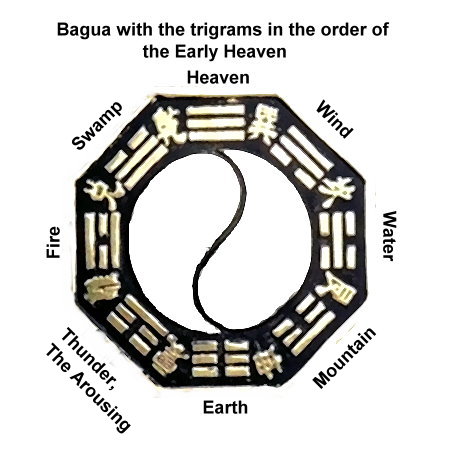
I drew a circle and ordered the eight trigrams on it at this: heaven above, earth below, fire in the middle left, water in the middle right, the remaining four trigrams also according to the circle of early or original heaven, the mythical ruler Fuxi is attributed. According to tradition, the Three Pure as well has been assigned to the circle of the early or original heaven.

Then I drew the double lines between the two trigrams, which together make up a “pure” hexagram pair of heaven, one after another, twenty-two times. It seemed to develop a symmetrical structure. When I was finished I had to look twice and three times on it. I could hardly believe it: There was a pleasing symmetrical diagram (see Fig above), which is without doubt  an emblem of heaven. Spontaneously, I called it “The Threefold Temple of Heaven”.

The double-lines, which express the pure hexagrams pairs extend symmetrically to a central axis. The display shows three overlapping cross-roofs, each of which are supported by one central post.
Two perpendicular lines are forming the double bottom.

The two double lines, on which the temple is standing, symbolize the basis for life on Earth. The double line between fire and earth represents the rising and setting sun and day and night (hexagrams 35 and 36), the double line between water and earth the falling of rain on earth (hexagram 8) and the water contained in the earth and gushing from wellsprings (hexagrams 7).  The central pillar of “The Threefold Temple of Heaven”, is formed by the two most important hexagrams of the I Ching, namely the hexagrams

11. T’ai / Peace with the trigrams Heaven / Earth

12. P’i / Standstill (Stagnation) with the trigrams Earth / Heaven

The central pillar is connecting heaven and earth and corresponds to the world ash tree in Germanic mythology, also connecting heaven and earth.
What should this “Threefold Temple of Heaven” represent?


reinheit-1-pictogram-mountain-in-the-bronze-font.jpg

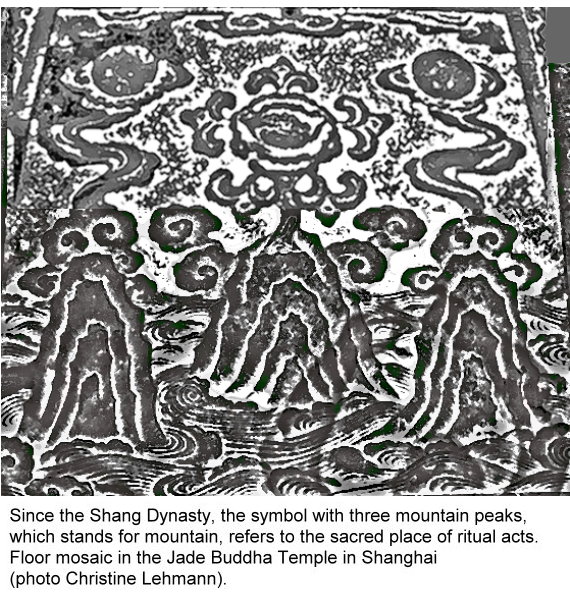
reinheit-2-floor-mosaik-in-the-jade-buddha-temple-in-shanghai-of-the-three-peaks-of-a-mountain-as-sacred-places.jpg

The diagram of the eleven pure hexagram pairs remembers of an ancient symbol with three mountain peaks, which stands for mountain. (1650-1050 BCE.) Since the Shang Dynasty, it refers to the sacred place of ritual acts. It is one of the most common characters written.
In the oracle bone inscriptions (17th-11th century BC), the three peaks are equally high, but since the bronze font (11th century-256 BC) the middle peak is higher than the other two.

Maybe the figure shows the three peaks of a sacred mountain. According to old ideas are mountain peaks sacred places where the worlds of the profane mingle with those of the divine, and on which a passage from one to the other world is possible. The mythical ruler Fuxi, which is associated with the circle of the Early Heaven, is until today depicted as a mountain. The head of Fuxi rises from the top of the mountain shrouded by foliage. Peaks appear to the people especially “pure” when they are covered by pristine white snow reflecting sunlight. This is a grand sight.
The gender of the Xia (about 2200-1800 BC.), whose origin is Fuxi, led off their power from the religious worship of sacred mountains.

In particular, the mountain Tai Shan in China is the place to meet the deities of heaven and earth. Located in the east, the Tai Shan represents  sunrise, spring and a new beginning. For new dynasties he was of great ritual significance. A ruler had only the mandate of heaven after he had made his respects to this mountain. Only on Tai Shan is said to be the ruler possible to perform the feng and shan sacrifices, and to communicate with the heaven.
Until modern times, there has been the cult of sacred mountains. The five sacred mountains of Taoism were especially of great importance in China’s ancient world. They are located in all five directions, and are places of sacrifice since time immemorial. On their summits are many Taoist temples.

reinheit-1-the-hall-of-prayer-for-good-harvest-of-the-temple-of-heaven-in-beijing.jpg

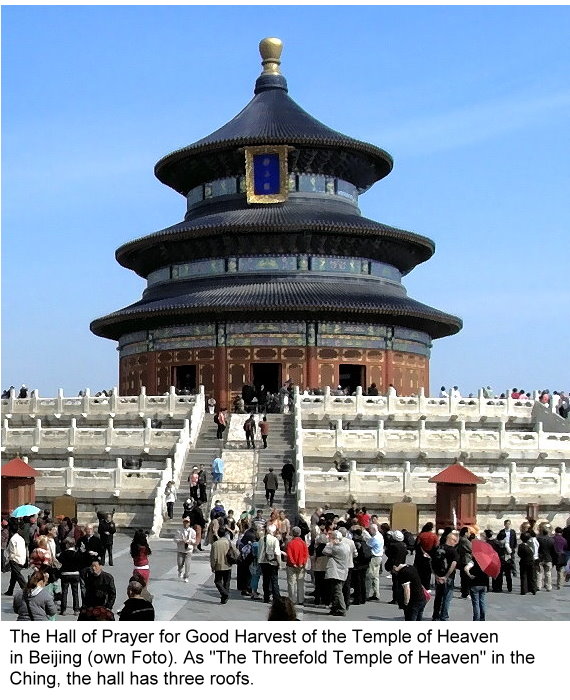
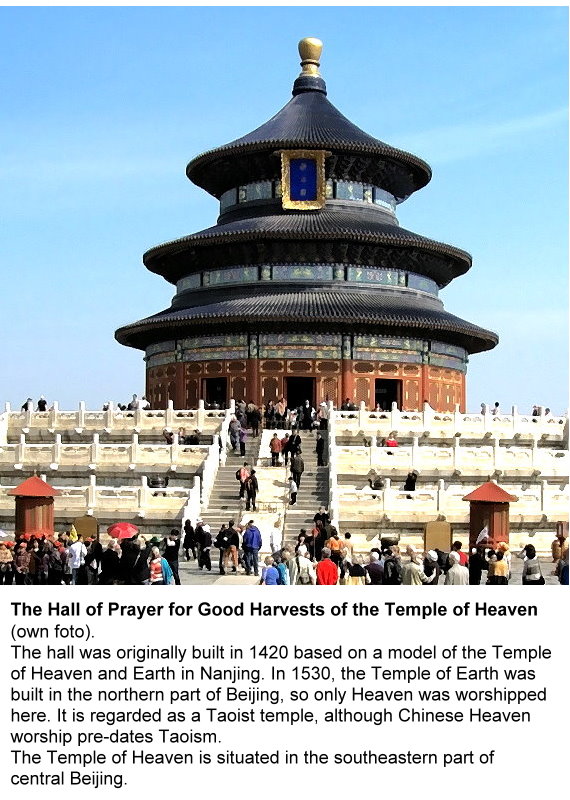
In the Temple of Heaven in Beijing with its three stacked roofs since the Ming-dynasty the emperor performed the sacrifice at the winter solstice and prayed. The rectangular three-level terrace, on which the temple stands, is the earth, nature and the human world. The three-tier roof with the blue bricks and the crowning jewel, however, means the golden heaven. It is supported by pillars, which represent the seasons.
The “Threefold Temple of Heaven” I rediscovered in the I Ching, corresponds in shape more like a holy mountain. In any case, so the Heaven was appreciated. The Zhou (1050-226 BC.), which have provided the hexagrams with texts derived their power from the heaven. They were organized patriarchal and felt even more than the other dynasties before them as the sons of heaven, as did also the later Chinese rulers until the twentieth century.

“The Threefold Temple of Heaven” is a sacred emblem. The diagram has a share at the “middle” and power of the Holy room, as center of the world, in which heaven and earth are touching and where it is possible to communicate with the Eternal.
 

29.6.2011

I Ching Secrets 30.06. to 27.07.2011: In the Forbidden City in Beijing and in the temples and monasteries in China, Dragon-Lines (Leylines) intersect. They give residents and visitors life force and carry the information of the rites performed here in the country!

Abgelegt unter: Allgemein — admin @ 14:46

In the Forbidden City in Beijing and in the temples and monasteries in China, Dragon-Lines (Leylines) intersect. They give residents and visitors life force and carry the information of the rites performed here in the country.

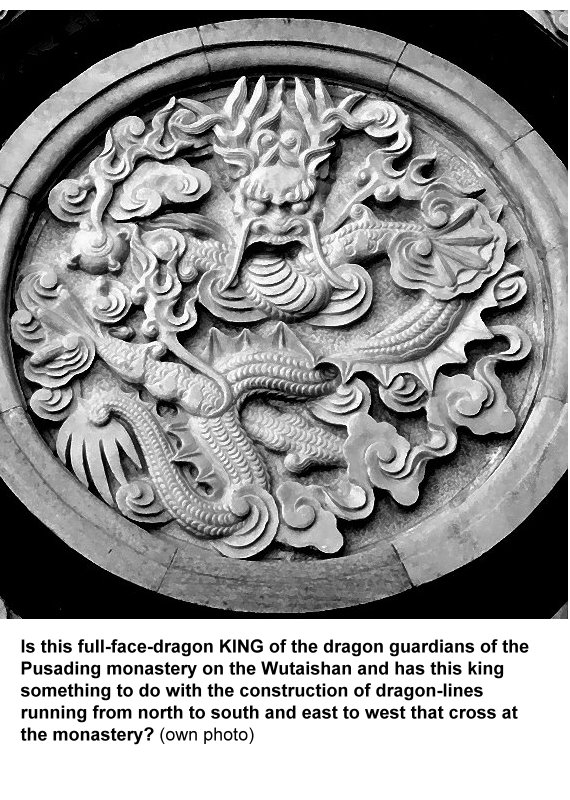
pu-full-face-dragon-at-the-pusading-monastery.jpg

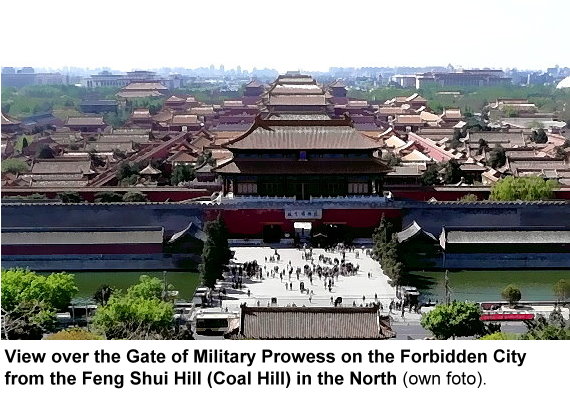
In the last Weblog has been shown that the large-scale structure of the Forbidden City in Beijing matches with the graphic representation of the most important I Ching hexagrams. (Required for compliance is the arrangement of the eight trigrams on a circle in the order of the Early Heaven.) The imperial Palaces in the Forbidden City are located on the north-south axis, which connects in the I Ching, the trigrams Heaven and Earth and the hexagrams 1 and 2. The positions of the double signs (hexagrams, constituted of two identical trigrams) in the I Ching correspond to the positions of the altars in the Forbidden City. Of the four altars only the Temple of Heaven is still there.

Hexagrams 1 and 2 are named:

Hexagram 1) Ch’ien / THE CREATIVE, which is composed of six yang lines (twice the trigram heaven) is in the I-Ching in the south,
Hexagram 2) K’un / THE RECEPTIVE, which consists of six yin lines (twice the earth trigram) is in the north.
The two Hexagrams 1 and 2 are the strongest pair of all I Ching Hexagram-pairs. They are the only ones, of which the description speaks of dragons. The dragon represents the strongest expression of creativity, the I-Ching says.


The Sinologist Joseph Good writes:
“According to ancient Chinese idea Fuxi and Nuwa are the first human couple from whom descended the whole human race, especially the Chinese themselves. Fuxi and Nuwa both are descended from dragons. These have a human torso and a snake-like lower body. The Dragon can’t  be defeated by any creature in this world … and he also became the emblem for China and the special emblem of the emperor, the Son of Heaven on the dragon throne.”

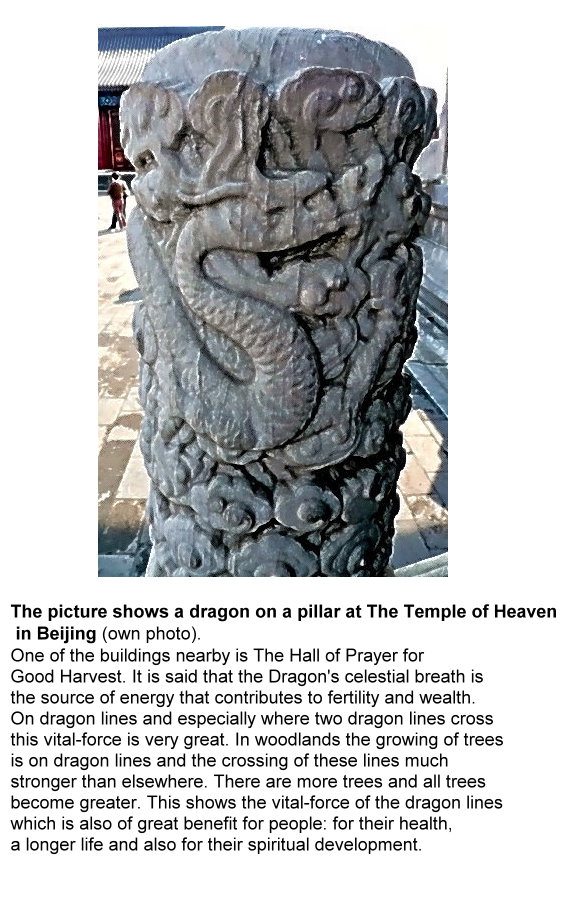
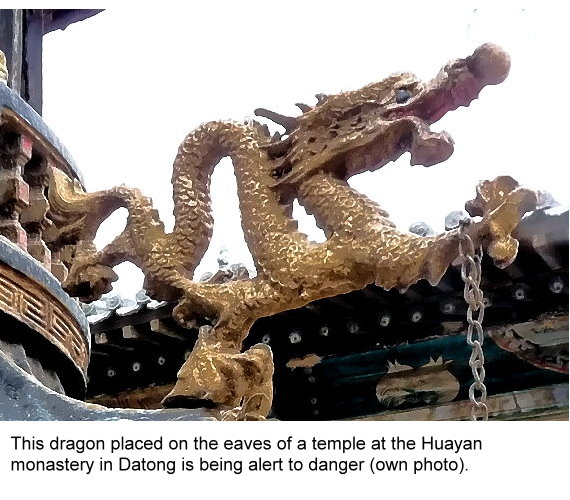
In China, dragons are generally friendly to the people and have great power. The dragon-lines (in Europe called Leylines or Geomantic zones) are attributed to them. They border the areas of powerful spirits of nature against one another. Nature spirits that are seen as dragons patrol on these lines. From the origin, the Chinese dragons are mainly responsible for rain and fertility. The number of dragon deities, revered in China, is large. Every sea, river, stream and lake, pond and pool is guarded by a dragon, just as the rain clouds. These are dragons of the water. There are also dragons of the earth, the heaven and other ones.


pu-dragon-on-a-pillar-at-the-temple-of-heaven.jpg

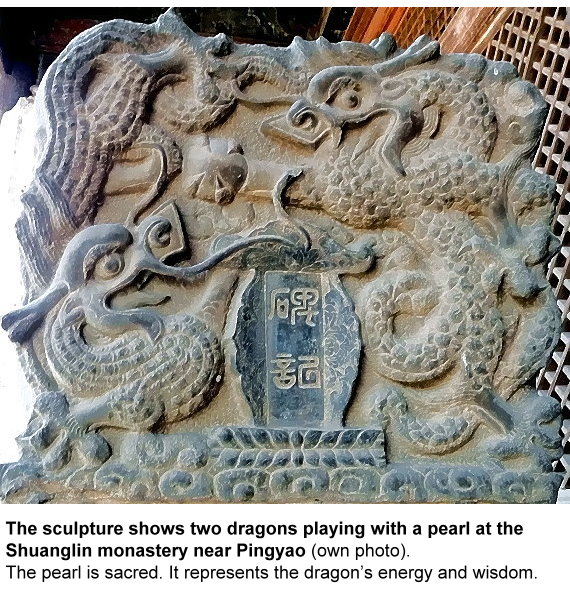
pu-two-dragons-playing-with-a-pearl.jpg

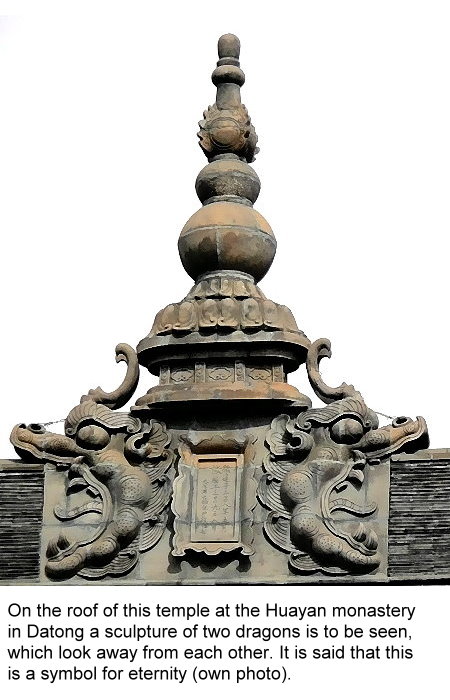
pu-two-dragons-as-a-symbol-for-eternity.jpg

Since the connecting line between the hexagrams 1 and 2, connects two hexagrams, that dragons are attributed, the connection line between the two hexagrams can be called a dragon-line. If the I-Ching is used as the Master Plan for the seat of an emperor or a monastery this includes the following requirement: The north-south axis of the planned facility must be a dragon-line that is crossed by an east-west dragon-line in the center. That is the demand of the I Ching. When there are no dragon-lines they can be installed by Dragons. The Dragons will do this, when monks asking them for it by prayers, sacrifices and rites. Then subtle energies are available to residents and visitors of these places that enhance their vitality. In addition, the rites, that they are performing, influence the surrounding country. In the Forbidden City in Beijing, this is realized. In its center, two major dragon-lines cross each other, one of which is in north-south direction over the Feng Shui hill, the other runs in east-west direction. The subtle energies of the dragon-lines and especially of their intersections increase the vitality of the people who are at these places. They become healthier and live longer. In addition, the power and information of the rites, conducted by the emperor, was transported by the dragon-lines out into the countryside, where they influenced the local people and other beings.

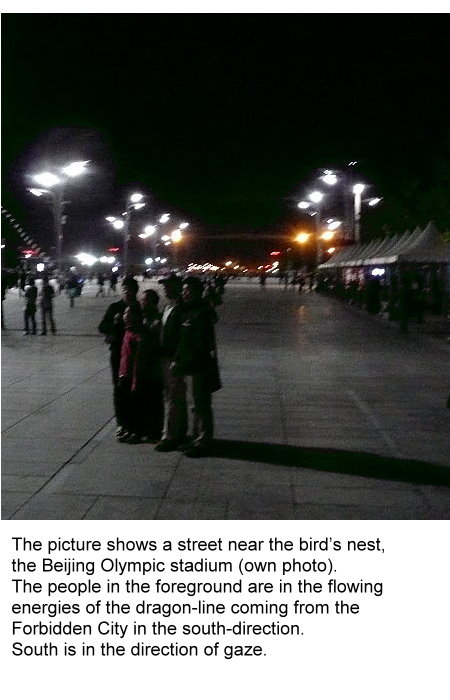
pu-this-street-near-the-birds-nest-is-a-dragon-line.jpg

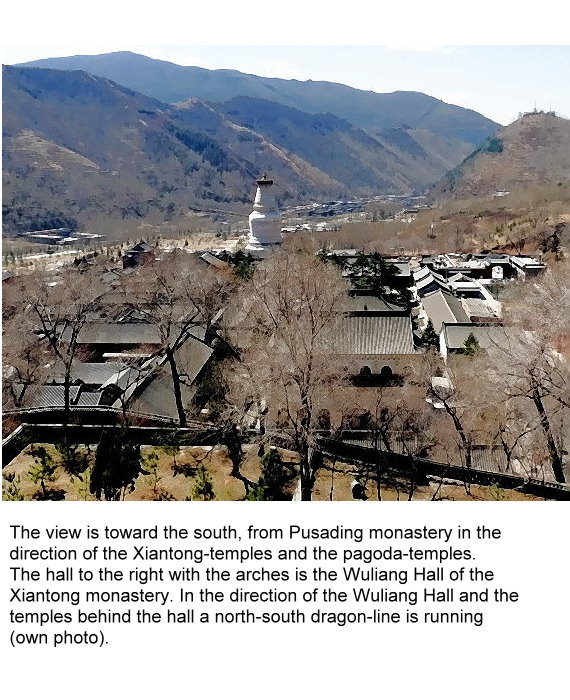
pu-view-from-pusading-monastery.jpg

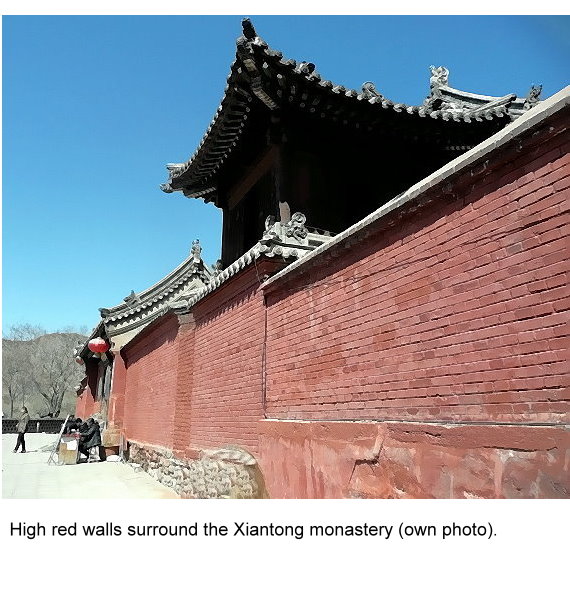
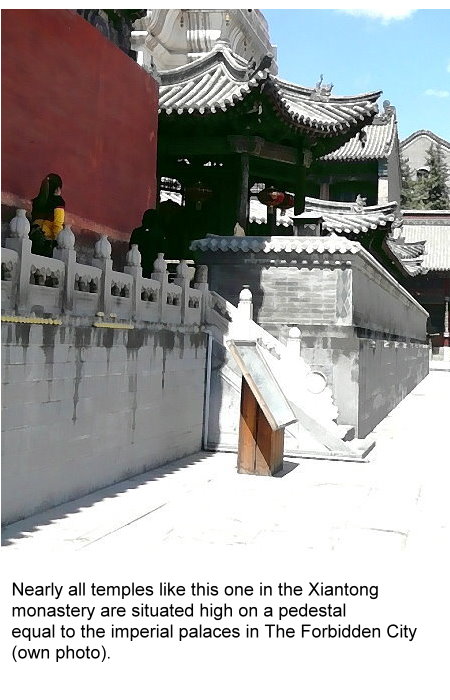
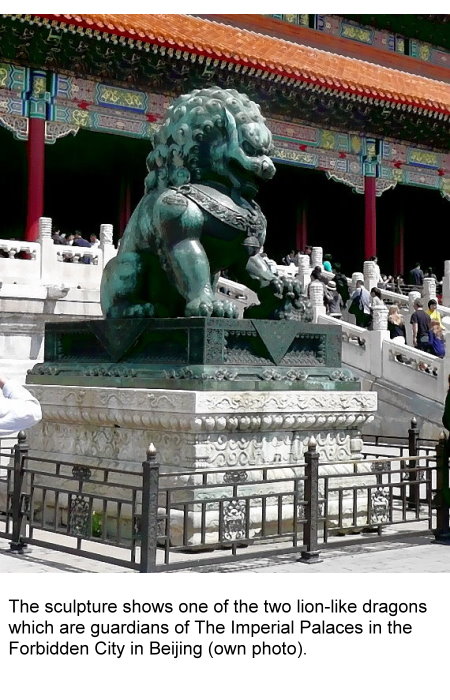
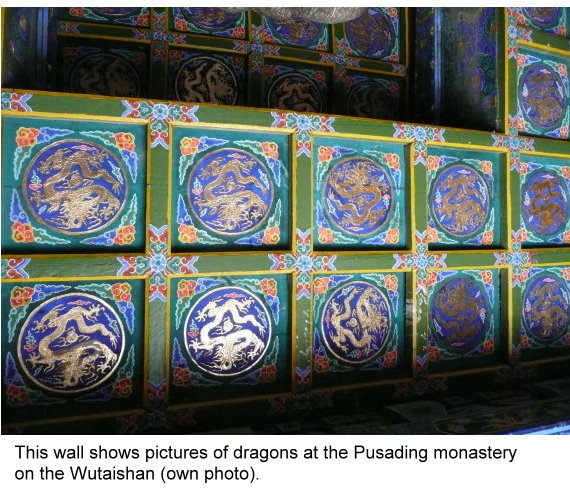
The Chinese Monasteries are in several aspects similar to The Forbidden City in Beijing. They are, with some exceptions, arranged symmetrically in rectangular or square building complexes along a north-south axis and are usually surrounded by a high red wall. The main temples are situated high on a kind of platform on the north-south axis and there are many illustrations of dragons. They are to be seen as paintings, mosaics pictures and as stone reliefs. This all is similar to the Forbidden City in Beijing.

pu-high-red-walls-surround.jpg

pu-tempel-on-a-pedestal.jpg

pu-one-of-the-lion-like-dragpms-as-guardians-at.jpg

pu-dragon-alert-to-danger.jpg

pu-wall-with-dragon-pictures.jpg

The most important agreement but is that two dragon-lines intersect in the center of the Forbidden City in Beijing as well in the center of the monasteries. One of them runs in the north-south direction and the other east-west. The author observed this at the Forbidden City in Beijing and in all twelve monasteries he visited on a tour of China.

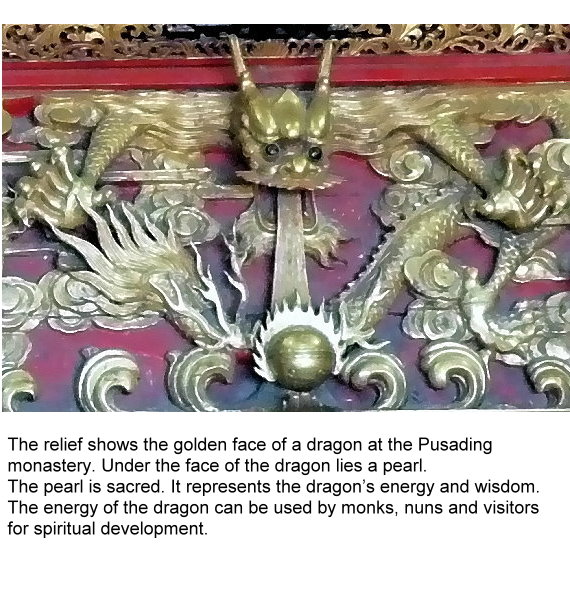
But something important also is else in the monasteries and temples than in The Forbidden City: The dragon energy in the monasteries and temples is intended to use for spiritual development of the nuns, monks and visitors. In meditation this energy is accumulated. Dragon energy is necessary for the transformation connected with the spiritual development.

pu-the-golden-dragon-and-its-pearl-at-the-pusading-monastery.jpg

Chinese people knew this, as an old story shows, an abbess refers to in the sermon to her nuns more than 1000 years ago. “There has not yet been a single recorded case of someone’s becoming enlightened (of the nuns)”, she says, “whereas as soon as the Dragon’s King daughter appeared, the entire great assembly was inspired” (to advance along the spiritual path).

28.5.2011

I Ching Secrets 02.06. to 29.06. 2011: Is the Earth Emblem of the I Ching, the Master Plan of the ritual structure of the Forbidden City in Beijing?

Abgelegt unter: Allgemein — admin @ 11:54

Is the Earth Emblem of the I Ching, the Master Plan of the ritual structure of the Forbidden City in Beijing?

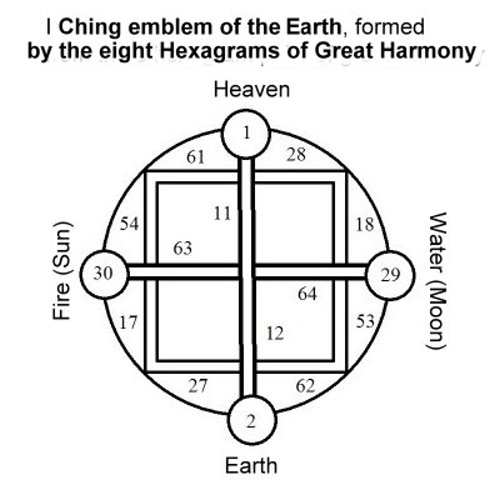
1085-i-ching-emblem-of-the-earth.jpg

forbidden-city-1-view-on-the-forbidden-city-from-the-feng-shui-hill-in-the-north.jpg

In the Forbidden City in Beijing, the Heaven, Earth, Sun and Moon Altar were located in the directions in which in the Emblem of the Earth
the hexagrams with twice the trigram Heaven, Earth, Fire (Sun Fire) or
Water (lunar forces) have their place. (South is in the Emblem of the Earth above, North is in the Emblem below, East at the left and West at the right.)
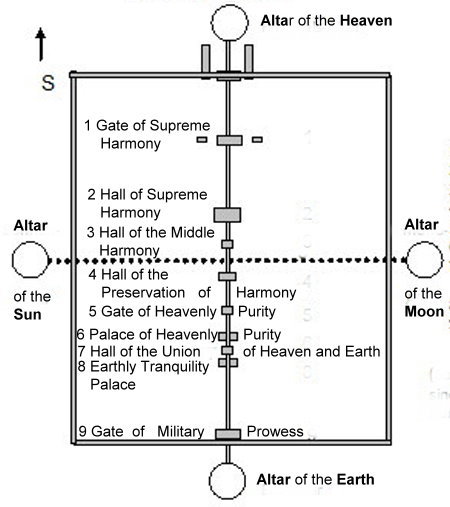
In the Emblem of the Earth the South-North axis is connecting Heaven and Earth. In the Forbidden City Beijing on the South-North axis the Altar of Heaven and the Altar of Earth were situated. The East-West axis in the Earth-Emblem connects Fire and Water, in the Forbidden City on the East-West axis the Altar of the Sun and the Altar of the Moon had their place. Furthermore on the South-North axis in the Forbidden City the Halls of Supreme Harmony, the Palaces of the Highest Purity and the Hall of contact with Heaven and Earth are located.
The connecting line between the hexagrams with twice the trigram 
Heaven resp. Earth is in the I Ching (Circle of the Early Heaven) one of
the two lines of Supreme Harmony and Highest Purity.
The second of these two lines is the East-West axis,
which in the Earth-Emblem connects the hexagrams with twice the trigrams Fire resp. Water. In the Forbidden City in Beijing, the East-West axis connected the Sun Altar and the Moon Altar.
On the South-North axis of the Forbidden City the buildings have 
properties that are the same as those of the South-North axis and the East-West axis of the Emblem of the Earth in the I Ching. These two lines namely have the properties of Supreme Harmony
and Highest Purity. Buildings with these properties are on the
North-South axis of the Forbidden City the Gate and the Hall of Supreme Harmony, the Hall of Mean Harmony, the Gate of Heavenly Purity, the Palace of Heavenly Purity and the Palace of the union of Heaven and
Earth. (See Figure).

forbidden-city-1-map-with-temples-and-halls-and-palaces-on-the-south-north-axis.jpg

Halls and Palaces on the South-North axis in the
Forbidden City bear the names of the properties of
the South-North axis of the Earth Emblem of the I Ching. 
The arrangement of the Altars in the Forbidden City is also in agreement with the structure of the Earth Emblem in the I Ching.

In the Forbidden City the official cult of the archaic Chinese
found his last expression says the Sinologist Frank Fiedeler in his book “Yin and Yang, The cosmic pattern in the Chinese culture “. Built in the Ming-Dynasty (1368 -1644) the ritual structure of the Forbidden City goes back to the forms of ritual of the Zhou dynasty (1050-256 BC), as far as these were handed down.
The ritual structure of the Forbidden City with its
Imperial Halls and Palaces roots therefore as well as the I Ching in the Chinese Antiquity.
To this day, the two axes in the Forbidden City are still the central axes of Beijing. In rectangular form the walls of the area have a length of 960 m South to North and 750 m East to West. Their directions of the walls correspond to the directions of the square of the Earth Emblem
the length of the enclosed area is larger, however, as its
width.
The Forbidden City has an area of
​​
720 000 square meters,
72 times 10 000. The number 72 is something special.
In Chinese culture it is mainly the product of 9 (provinces)
and 8 (directions) and thus also perfect as fortunate. (In old Europe, the number of countries and languages
​​in the world was generally assumed to be 72.) As popular symbol appears the number 72 also in other links.
Confucius for example is said that he has had 72 students.

Originally the 72 is a cosmic number. 

The four hexagrams with twice the trigrams Heaven, Earth, Fire or
Water, have in the Emblem of the Earth their place in the four main directions. They have their place there where in the Circle of the Early Heaven the trigrams are located from which they are composed. 


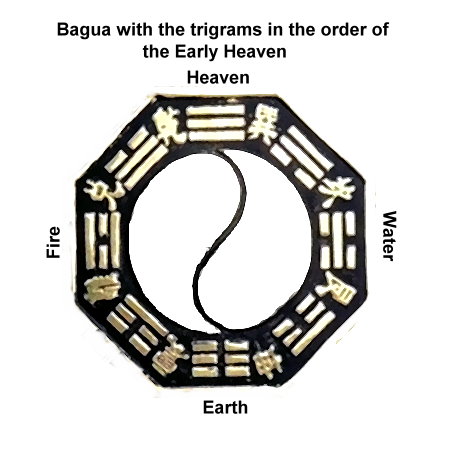
forbidden-city-1-bagua-with-the-8-trigrams-in-the-order-of-the-early-heaven.jpg


In respect to their significance and their geographical location these four hexagrams correspond to the Altars of the Forbidden City in the South, North, East and West. From them, however, today only the
Temple of Heaven in the South is available. The other three were transformed after the end of the Qing dynasty in 1911.


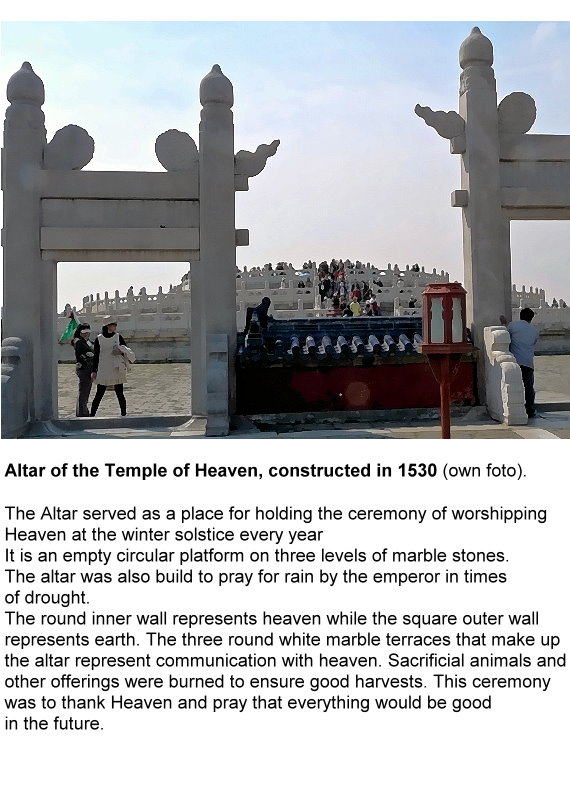
forbidden-city-1-altar-of-the-temple-of-heaven.jpg


forbidden-city-1-the-hall-of-prayer-for-good-harvests-of-the-temple-of-heaven.jpg


The sacrificial Altar of the Heaven was in the Temple of Heaven in
South of the capital - in the Earth Emblem that is above, where the hexagram with twice the trigram Heaven has its place. The Earth Altar was in the North, where in the Emblem of the Earth the hexagram with twice the trigram Earth has its place. (In ancient Chinese Maps South is above, North, down, East at the left and West at the right.)
The Altar of the Sun was in the East, the Altar of the Moon in the West of
the Forbidden City. This is in the ritual book Liji explained by the fact that the Morning Sun rises in the East, while the Moon after his
disappearance every month appears again at the Western evening sky.
The Altar of the Sun was in the Forbidden City, therefore, where in the Emblem of the Earth is the hexagram with twice the trigram Fire
Fire also means the Sun. The Moon Altar was there
where in the Emblem of the Earth the hexagram with twice the trigram Water has its place.
To the trigram Water lunar forces are assigned.
The Altars of Heaven, Earth, Sun and Moon were there where in the
Emblem of the Earth the hexagrams with the trigrams of these names are to be found. The color of the temple of Heaven located in the South is blue, the Earth-Altar in the North had a yellow color, the Sun Altar in the East was red and the Moon Altar in the West was white.
The big Heaven victim advised the Emperor to the winter solstice
at the longest night of the year, the big Sacrifice for the Earth was on the day of Summer solstice. The date for the offering to the Sun was the
Spring Equinox, the time for offering to the Moon, the equinox in the fall.
The South-North axis in the Emblem of the Earth is the visual equivalent
of the hexagram pair 11/12 with the meaning of peace and stagnation or Harmony and disharmony. In it combine the trigrams
Heaven and Earth. It represents the two solar cycles of the end of summer in the first year.
The East-West axis in the Emblem of the Earth is the pictorial representation of the hexagram pair 63/64 with the meaning “before and after completion”. In it the trigrams Fire and Water are combined. It represents the two solar cycles of the autumnal equinox in the 3rd year.
The emperor and his entourage moved at the equinoxes
on this axis to the Altars of the Sun and the Moon to offer their sacrifices.
Great Harmony and great Purity exhibit of all 32 hexagram pairs only these two pairs of hexagrams 11/12 and 63/64. (The definition of High Purity will still be given.)
When the emperor in the course of the year these four great places of sacrifice in the four cardinal directions visited, he did this
for the maintenance and renewal of Harmony between Heaven, Earth and Man. To perform the great sacrifices, he moved with his entourage to the
Solstices on the South-North axis and to the Equinoxes on the East-West axis.
For the winter Solstice 1748, the “procession” as Painting on a seventeen-meter-long role is noted.
Because the South-North axis connects Heaven and Earth
and balances Harmony and Disharmony
it is more important and has more “holiness” as the
East-West axis, especially since the emperor was regarded as the Son of Heaven and the Empress as representing the Earth.
In the pavement of the South-North road the central axis is marked. The emperor was carried over it in a Litter. For mere mortals it was forbidden to go there.

The most important buildings of the Imperial Palace are in the following listed. (see Figure 2):
After the Gate of Supreme Harmony follows,
the Hall of Supreme Harmony, then
the Hall of Middle Harmony and
the Hall of the Preservation of Harmony.
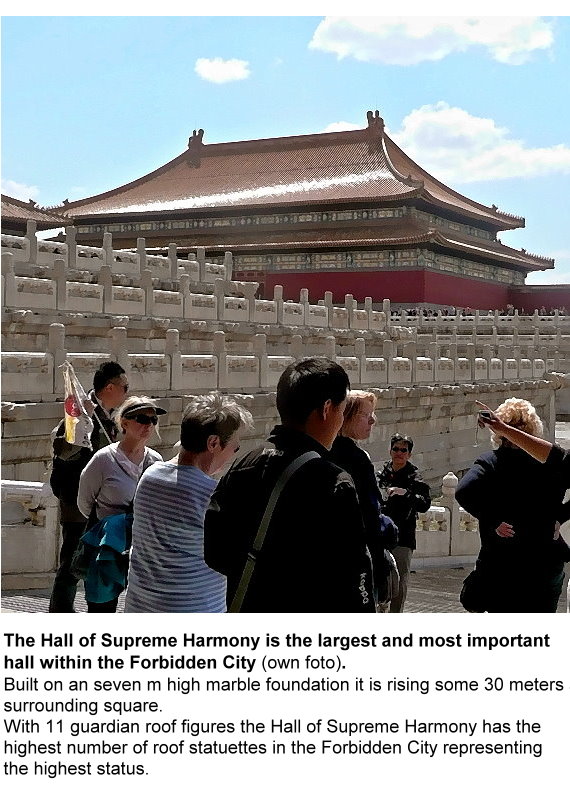
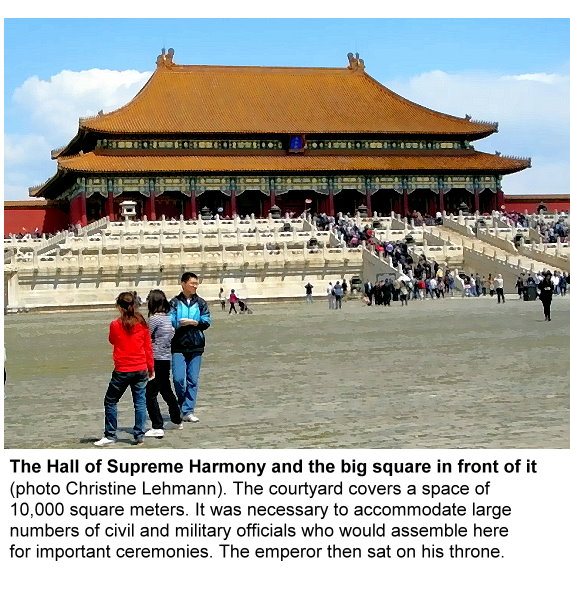
The Hall of Supreme Harmony was to be the center of the Forbidden City. It is the highest and largest building there. Here the emperor was enthroned on his dragon throne.

The sloping ridges of building roofs are decorated with a line of statuettes. The number of statuettes represents the status of the building. The Hall of Supreme Harmony has 11, the only building in the country to be permitted this in imperial times.


forbidden-city-1-the-hall-of-supreme-harmony.jpg


forbidden-city-1-the-guradian-roof-figures-on-the-hall-of-supreme-harmony.jpg


forbidden-city-3-hall-of-supreme-harmony-and-the-big-square-inf-front-of-it.jpg


The Hall of Middle Harmony was the geometric center of the Forbidden City.
Here, the emperor made arrangements for the big ceremonies in the Throne Room.
After the Hall of the Preservation of Harmony
follows on the South-North axis 
the Gate of Heavenly Purity, then
the Palace of Heavenly Purity and
the Hall of the Union of Heaven and Earth.
The Palace of Heavenly Purity was originally the
Residence of the Emperor.
The Halls and Palaces on the South-North axis of the Forbidden City bear names with the most important properties of the corresponding axis in the Earth Emblem of the I Ching. These properties are the Supreme Harmony, the Highest Purity and the Touch of Heaven and Earth.
Therefore and because the arrangement of the four Altars of the Forbidden City corresponds with hexagrams in the Emblem of the Earth of the I Ching there is much evidence that the Earth Emblem of the I Ching is the Master Plan for the ritual structure of the Forbidden City in Beijing.

The Imperial Palace is in the traditional worldview of the Chinese
Center of the Chinese empire and the center of the world in general.
The Imperial Palace was a mirror image of the cosmos, the place where Heaven and Earth Meet and Yin and Yang penetrate each other harmoniously. The Emperor was compared with the Polar Star, that immovable in his place stands and on the path of all the stars aligned.
As the Emperor the Heaven the active force Yang
represented, so the Empress stood for the Earth and the receiving
Yin force. When Emperor and Empress came together
the two forces, Heaven and Earth, merged into one unit and
created Harmony. The residential houses in Northern China were
as the preferred site of the Forbidden City in South-North direction
aligned. The main building as the Palace of Supreme
Harmony was built at a central location on the South-North axis.
They wanted to ensure in this way that the Main building and its occupants were given as much Sun as possible. When in ancient times human pairs in China and elsewhere in the spring in the fields as part of a fertility cult combined, so they performed as the Son of Heaven and his Wife the sacred marriage between Heaven and Earth and created so Harmony for themselves and their fields.

Ultimately, Harmony and Purity is applied on a smaller scale and less perfect for every yard and every field that according to the structure of the Earth Emblem is aligned.
 
Is the ancient Chinese view of the world with their quest for Harmony and
Purity today only history? I think not. It is now not only limited to China, but their roots have with the Tao Te Ching, the I Ching, and finally with feng shui, the art of geomancy, spread over large parts of the world. When Joseph Needham in his book “Science and Civilization in China”
Geomancy regards as a pseudo-science, as not long before
acupuncture was seen, he recognizes but their positive impact in the following point: “… the Geomancy seems always to have a very aesthetic moment. Therefore, the beauty of the situation comes from so many
farms, houses and villages in China.”
This beauty of the situation, certainly not limited to the
“Aesthetic moment” is good at any time and for any place of the
World.

2.5.2011

I Ching Secrets 03.05. to 01.06. 2011: The hexagram pairs of Great Harmony form the old pictogram “Residence of Mankind”! They summon harmony for the earth!

Abgelegt unter: Allgemein — admin @ 13:02

The hexagram pairs of Great Harmony form the old pictogram “Residence of Mankind”! They summon harmony for the earth!

In the last blog hexagram pairs of harmony were defined. Hexagram pairs of harmony compensate the “imbalance of Yin and Yang”.
Yin and Yang are balanced in a hexagram pair when each of the six places of the two hexagrams is occupied by a Yin line and a by a Yang line. The two hexagrams that do this, commonly referred to as complementary.  To be a hexagram pair of harmony the two hexagrams must also belong to the same pair group. The ordinal numbers of the two hexagrams can be further apart, but they can also follow one another directly. If the complementary hexagram with an even atomic number follows the hexagram of the preceding odd atomic number, then I call such a hexagram pair a hexagram pair of Great Harmony. Such a hexagram pair is not only a couple, because they are balancing yin and yang on each of its six places and they are belonging to the same pair group, but they also form a pair due to their ordinal numbers. An example for this is the hexagram pair 29/30.


1085-hexagrams-29-und-30.jpg 

The following table shows the eight hexagram pairs of Great Harmony. At the same time the table shows the solar periods, which are represented by these hexagram pairs:

Table

       The eight Hexagram Pairs of Great Harmony

Hex. 11) Peace 11 End of Summer
12) Stagnation 12 End of Summer
17) Following 17 End of Autumn
18) Work on What Has Been Spoiled 18 End of Autumn
27) Providing Nourishment 3 Spring Equinox
53) Development 5 End of Spring
54) The Marrying Maiden 6 End of Spring
61) Inner Truth 13 Begin of Autumn
62) Preponderance of the Small 14 Begin of Autumn
63) After Completion 15 Autumn Equinox
64) Before Completion 16 Autumn Equnox
1) The Creative 1 Begin of Spring
2) The Receptive 2 Begin of Spring
29) The Abysmal, Water, Moon 5 End of Spring
30) The Radiating, Fire, Sun 6 End of Spring

Hexagrams can be represented graphically by connecting the two trigrams, they consist of, by a straight line. If the first six hexagram pairs of great harmony in this way are graphically represented in the circle of the Early Heaven, one obtains the following diagram:

 1085-diagram-of-the-first-six-hexagrams-of-great-harmony.jpg

What is the meaning of this Diagram?


In the lexicon of Chinese Symbols by Wolfram Eberhard I read something like:
The earth is square in the old view of the Chinese and divided into rectangular fields, houses, city borders etc. The Chinese cities, where geologically possible, are built in the form of a square. While a circle is the symbol of the Heaven, the earth is symbolized by a cross and a square, independently of the pictogram for the earth in use today.
When I was looking in a dictionary of Chinese Pictograms for a square with a cross in it I found a square with a parallel to the sides adjusted cross as the pictogram for a field.
 1085-residence-of-mankind.jpg
In the oracle bone writing (BC 17 to about 11 cent.) the meaning of this pictogram, however, was comprehensive and more important. At that time this pictogram meant Residence of mankind. It seemed to me that the diagram that was build up by the hexagrams of great harmony was the emblem for Mother Earth? The pictogram seems to summon great harmony for the earth.

Two of the hexagram pairs are part of the pair group heaven / earth, two of the hexagram pairs part of the pair group man / earth and four hexagram pairs part of the pair group heaven / man. Since the latter hexagram pairs represent the ends of the seasons, they are more pronounced than the beginnings of seasons, and solstices and equinoxes.
Spring and autumn are present with all solar periods, the winter with no solar period and the summer with only two. The beginning of summer and the summer solstice are missing. The summer solstice was considered a less favorable time, as after the days are shortening.
Great Harmony is thus summoned to the earth, especially in spring when sown, and for the autumn when the fruit is harvested. This and the lack of winter probably means that the diagram is a conjuration of the harmonious growth and harvesting of grain and other crops to feed on the people. The emblem of Mother Earth is apparently part of the agri cult. The change in the meaning of the pictogram, supports this. In earlier time it meant the residence of man, now a field. 

The two major hexagram pairs 1) heaven / heaven, 2) earth / earth and 29) water / water, 30) fire / fire are also Hexagram Pairs of Great Harmony. They are represented by circles around the trigrams from which they are composed.
1085-i-ching-emblem-of-the-earth.jpg  

There remains the question of the meaning of these four hexagrams with two identical trigrams heaven, earth, water (moon) and fire (sun). The circles at the ends of the cross, which represent these hexagrams, correspond to the points at which in the Forbidden City in Beijing the Temple and Altar of Heaven, the Temple and Altar of Earth, the Temple and Altar of the Sun (trigram fire) and the Temple and Altar of the Moon (trigram water) have or had their place. Maybe these four hexagrams represent these temples and altars?

2.4.2011

I Ching Secrets 06.04. to 02.05. 2011: The beautiful triple star of harmony – the fingerprint of the structure of the I Ching!

Abgelegt unter: Allgemein — admin @ 11:34

The beautiful triple star of harmony – the fingerprint of the structure of the I Ching!

1079-this-3-headed-deity-corresponds-ot.jpg

The beautiful triple star of harmony – the fingerprint of the structure of the I Ching!


Previous weblogs show how the 32 Hexagram pairs of the I-Ching are divided in three pair groups, namely in the Hexagram pairs of the pair group Heaven / Earth, in the Hexagram-pairs of the pair group Man / Earth and in the Hexagram pairs of the pair group Heaven / Man. The Hexagrams of the three pair groups differ by their meaning, their distribution of trigrams and their Hexagrams, consisting of two identical trigrams. The latter are the leaders of the three pair groups. The Hexagrams of the pair group Heaven / Earth represent the seasons starts and a new beginning, the Hexagrams of the pair group Man / Earth the equinoxes and solstices and the preservation of creation and the Hexagrams of the pair group Heaven / Man represent the ends of the seasons and the dissolution of creation. The three pair groups meet in Indian mythology, the three deities Brahma, the creator, Vishnu the preserver and Shiva the Destroyer.
Since it is known how the 64 Hexagrams of the I-Ching are distributed to these three pair groups, Hexagram pairs of harmony can be defined, comprising less than 32 Hexagram pairs.
In what ways can the beings and things and thus the Hexagrams gain harmony?
The Daodejing (Tao Te Ching in older spelling) (translation by Stephen Mitchell) says:
“All things have their backs to the female
and facing the male.
When male and female combine, all things achieve harmony”.
The following statements, which are attributed to Zhuangzi, is in line with this:
If Yin and Yang combine, he says, in substance, and
Harmony act, the things come into existence.
Elsewhere he says:
“The essence of the Dao is the cessation of opposites,” and continues:
“The union with the Dao is by correcting the imbalance of Yin and Yang.”

Based on these statements Hexagram pairs of harmony can be defined:
To form a Hexagram pair of harmony, the two Hexagrams must compensate the “imbalance of Yin and Yang”.
Yin and Yang, however, are in a Hexagram pair balanced when each of the six lines of the two Hexagrams is occupied by a Yin and a Yang line. The two Hexagrams that do this, commonly referred to as complementary. (Complementarity is a structural relationship between two trigrams or Hexagrams, in which each line of one is the opposite, i.e., Yin vs. Yang, of the other. For example, Water and Fire, and the Hexagrams 8) Holding Together and 14) Possession of great Measure.


1080-hexagram-pairs-of-harmony.jpg


The atomic numbers of the two Hexagrams can follow each other, but they may also be further apart.
If harmony  is ” The just adaptation of parts to each other, in any system or combination of things, as is said in a dictionary, then there is between a Hexagram and its complementary Hexagram harmony because on each of the six lines of the two Hexagrams, the two elemental forces Yin and Yang are in balance. But now, each of the 64 Hexagrams has its complementary Hexagram. To find a prominent group of Hexagrams of harmony, there must still be made a selection among the 32 complementary Hexagram-pairs:
Friendships and marriages between members of various ethnic groups are generally more stress exposed as a partnership between members of the same ethnic group. The causes are different manners
and traditions, different languages
​​
or different understanding of language. Between members of the same ethnic group these conflicts do not exist
and the conditions for harmony between the partners are better.
In analogy, one can assume that the compliance between a Hexagram and its complementary Hexagram is greater when both are members of the same pair group.
When a Hexagram and its complementary Hexagram belong to the same pair group of Heaven / Earth, Heaven / Man or Man / Earth, I think therefore the harmony between them is greater, as if the two partners are belong to different pair groups.
Such a complementary Hexagram pair therefore I define as a
Hexagram pair of harmony.
In the pair group Heaven / Earth, eight Hexagrams have their complementary partner in their own pair group
(Namely, the four complementary Hexagram pairs 1 / 2, 7 / 13; 8 / 14 and 61/62),
in the pair group Heaven / Man there are twelve,
(Namely, the six Hexagram pairs 5 / 35, 6 / 36; 11/12; 17/18; 29/30, and 53/54)
and in the pair group Man / Earth also twelve,
(Namely, the six Hexagram pairs 9 / 16; 15/10; 27/28, 51/57, 52/58 and 63/64).
These 16 complementary Hexagram pairs are according to the above definition, Hexagram pairs of harmony.

The graphical frequency distribution of the trigrams that make up these Hexagrams of harmony, shows in the circle of the Early Heaven the following figure:

1080-the-beautiful-triple-star-of-harmony-the-fingerprint-of-the-structure-of-the-i-chingufo.jpg


 I call the figure the triple star of Harmony.
The distribution of the trigrams of the 16 Hexagram pairs of harmony  separate for each of the three pair groups shows a beautiful and harmonious figure. In fact, there are three stars, from which  
the two stars of the pair groups Heaven / Earth and Heaven / Man
have their maxima at the trigrams Heaven and Earth
(The parents) as well as at the trigrams Water and Fire (the small parents). But the pair group Man / Earth has its maxima at the trigrams Wind and Lake, Thunder and Mountain (the children of the great and little parents). The focus is on the trigrams Heaven and Earth.

Why is the triple-star of harmony the fingerprint of the structure of
the I Ching?
The three pair groups form with their trigrams of its 16
Hexagram pairs of harmony this star. Since all complementary Hexagrams, which have their partners in their own pair group, contained therein, it is specific to the structure of the I Ching.

12.3.2011

I Ching Secrets 16.03. to 05.04.2011: One of the deep secrets of the I Ching: Why are the eight hexagrams, constituted of two identical trigrams, assigned to the ordinal numbers 1 / 2, 29/30, 51/52 and 57/58?

Abgelegt unter: Allgemein — admin @ 22:20

One of the deep secrets of the I Ching: Why are the eight hexagrams (four hexagram-pairs), constituted of two identical trigrams, assigned to the ordinal numbers 1 / 2, 29/30, 51/52 and 57/58.

The distribution of these eight hexagrams on the 24 Solar periods, the three annual cycles and the three pair-groups of hexagrams according to the nature of their ordinal numbers. 

The positions of the hexagrams composed of two   identical trigrams are not arbitrary.At the three annual cycles, the position of each of them is at the beginning as the first of its pair-group of hexagrams.   Each hexagram can be understood as composed of two constituent trigrams that consist of three lines. (There are two different kinds of lines, broken or not broken, Yin or Yang.) Eight hexagrams are constructed out of a single trigram that is doubled. The Chinese names of the resulting hexagrams are the same as the trigrams. Although the meanings are something different, the interpretation of these eight hexagrams has been strongly influenced by the meanings associated with their constituent trigrams.         1069-hexagrams-heaven-and-earth.jpg 

1071-the-creative-is-symbolized-by-the-horse-and.jpg

1069-hexagrams-water-and-fire.jpg

1075-the-abysmal-and-the-brightness.jpg1069-hexagrams-thunder-and-mountain.jpg

1069-hexagrams-wind-and-lake.jpg

1075-the-arousing-is-symbolized-by-the-dragon-the.jpg

1071-symbols-of-the-gentle-and-the-yoy.jpg 

The eight trigrams that constitute these eight hexagrams which are double signs are characterized as follows:God comes forth in the sign of Arousing; he brings all things to completion in the sign of Gentle; he causes creatures to perceive one another in the sign of Radiation (light); he causes them to serve one another in the sign of the Perceptive. He gives them joy in the sign of the Joyous; he battles in the sign of the Creative; he toils in the sign of the Abysmal; he brings them to perfection in the sign of Keeping Still.” “The Creative acts in the horse,the Receptive in the cow,the Arousing in the dragon,the Gentle in the cock,the Abysmal in the pig,the Radiation in the pheasant,Keeping Still in the dog,the Joyous in the sheep.”  (Discussion of the Trigrams in the Shuo Kua, translated by Richard Wilhelm) Are the positions of the eight hexagrams, constituted of two identical trigrams, within the 64 hexagrams reached by chance or by a rule? The positions of the atomic numbers of these eight hexagrams are1 / 2, 29 / 30, 51 / 52 and 57 / 58. They are arranged symmetrically on the Bagua of the Early Heaven and furthermore also symmetrically distributed on the three annual cycles as well as on the three pair-groups of hexagrams, according to the nature of their ordinals. Apart from this, however their positions seem to be arbitrary. In reality, this is not the case. How can this be shown? One comes closer to the solution of this question, if one looks at the positions of the four hexagram-pairs on the Solar cycle with its 24 Solar periods. 1069-the-8-hexagrams-represent-the-solar-periods-1-to-6-and-9-to-10.jpg The hexagram-pair 1 / 2 corresponds to the  Solar periods 1 and 2 of spring-beginning in the first year (hexagrams 1 to 24), the hexagram-pair 29 / 30 corresponds to theSolar cycles 5 and 6 of the end of spring time in the second year (hexagrams 25 to 48), the hexagram-pair 51 / 52 corresponds to the Solar periods 3 and 4 of the Spring Equinox in the third year (hexagrams 49 to 64) and the hexagram-pair 57 / 58 corresponds  to theSolar periods 9 and 10 of the summer solstice in the third year (hexagrams 49 to 64).  The hexagram-pair 1 / 2 is a member of the pair group Heaven / Earth which represents the beginnings of seasons, according to the nature of their ordinals. It corresponds to the first beginning of seasons in the first year, which is the beginning of spring-time in the first year. The hexagram-pair 29 / 30 is a member of the pair group Heaven / Man which represents the ends of seasons, according to the nature of their ordinals. It corresponds to the first end of seasons in the second year, which is the end of spring-time in the second year. The hexagram-pairs 51 / 52 and 57 / 58 are members of the pair-group Man / Earth which represents the equinoxes and the solstices, according to the nature of their ordinals. The hexagram-pair 51 / 52 corresponds to the first equinox in the third year which is the spring equinox in the third year. The hexagram-pair 57 / 58 corresponds to the first solstice in the third year which is the summer solstice in the third year. The positions of the eight hexagrams (four hexagram-pairs), constituted of two identical trigrams, therefore are outstanding. The I Ching seems to emphasize that they are the leaders of the different groups of hexagrams within the I Ching, the book of wisdom. 

Nächste Seite »

läuft stressfrei mit WordPress ( WordPress.de )